
The Three Day Dream: How Xiaomi Watch 5 Just Ended the Smartwatch Battery Wars
For years, smartwatch users have been forced to choose between features and longevity. Xiaomi’s newest flagship changes the game, proving that high-end performance can last nearly a week.
Key takeaways
- The Xiaomi Watch 5 uses silicon-carbon battery technology to achieve 3-5 days of heavy use, significantly outperforming Apple and Google flagships.
- It runs Wear OS 6 with a HyperOS skin, providing a rich app ecosystem while maintaining Xiaomi's signature power efficiency.
- A dual-chip architecture (Snapdragon W5 Gen1 and BES2800) is the primary driver behind the device's smooth performance and longevity.
- While high-end in design, the watch faces early criticism for inconsistent gesture controls and GPS accuracy that doesn't quite match specialized Garmin devices.
- The integration of Google’s Gemini AI marks a new era of smarter, voice-driven interactions for the Xiaomi wearable lineup.
A New Frontier in Wearable Longevity
Imagine a world where you can track your sleep, run a marathon with GPS, and keep your screen always on, all without hunting for a charger before the second sunrise. For nearly a decade, Apple and Google have trained us to accept a single day of battery life as the price of a high-resolution display and smart features. However, the newly released Xiaomi Watch 5 has officially shattered that compromise. According to reviews from Android Central, this device has quickly become the gold standard for Wear OS battery performance, delivering three to five days of real-world use even with heavy features enabled.
This is not just a marginal improvement; it is a fundamental shift in how we interact with our technology. While the Apple Watch Series 10 and the Google Pixel Watch 4 struggle to pass the forty-eight hour mark without aggressive power-saving modes, Xiaomi is leveraging a massive 930mAh silicon-carbon battery. This specific battery chemistry is the secret sauce. As reported by TechRadar, silicon-carbon technology allows for much higher energy density in the same physical footprint as traditional lithium-ion cells, potentially setting a new blueprint for the entire mobile industry.
The Silicon-Carbon Revolution
The Xiaomi Watch 5 does not achieve its legendary status through battery size alone. The watch utilizes a sophisticated dual-chip architecture, pairing the powerful Snapdragon W5 Gen1 with a BES2800 low-power co-processor. This setup ensures that the heavy lifting is handled by the main processor, while the secondary chip manages background tasks and the Always-On Display with minimal drain. PhoneArena highlights that this hardware synergy, combined with the new Wear OS 6 platform, creates a fluid experience that finally rivals the smoothness of Apple’s watchOS.
Context Box: The Wear OS Renaissance
For newcomers to the wearable space, Wear OS is Google’s operating system for smartwatches. For years, it was considered a distant second to Apple’s offering due to poor optimization and sluggish hardware. However, starting in 2024 and accelerating into 2026, the platform has seen a massive revival through partnerships with Samsung and Xiaomi. The result is an ecosystem that offers the customization of Android with the polished feel of a premium companion device.
Hardware and Design: Luxury Meets Utility
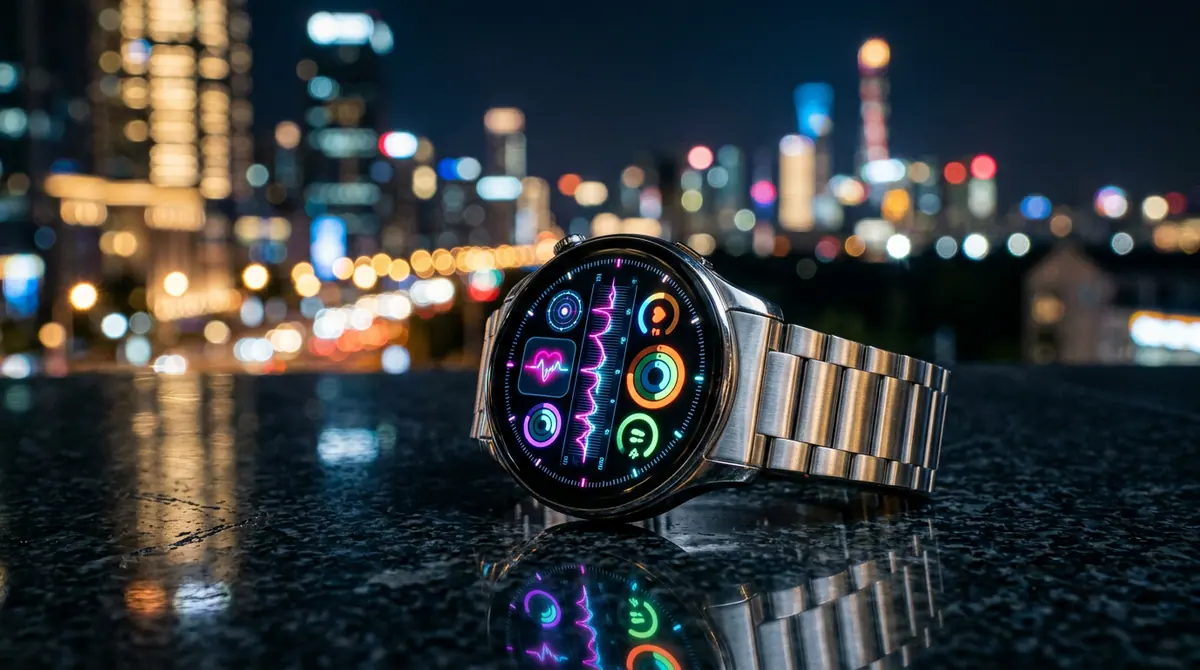
On the wrist, the Watch 5 feels like a statement piece. It features a 1.54-inch AMOLED display protected by sapphire crystal and housed in a rugged stainless steel body. The screen is capable of hitting 1500 nits of peak brightness, which, according to testers on YouTube, makes it perfectly legible even under direct midday sun. Xiaomi has also integrated Gemini AI directly into the interface, allowing for more natural voice interactions and smarter notification management than previous generations.
One of the more experimental features is the EMG gesture control system. Similar to the double-tap feature on the latest Apple Watch models, Xiaomi allows users to perform actions like pinching their fingers to answer calls or dismiss alarms. However, early feedback has been mixed. While the concept is futuristic, some reviewers have noted that the gestures can be unreliable, occasionally leading to frustrating missed interactions or unintentional commands.
What Changed: The Shift from HyperOS to Wear OS
In previous years, Xiaomi often utilized its proprietary HyperOS for its global watches, which offered great battery life but lacked the app ecosystem of a true smartwatch. The Watch 5 represents a major pivot. By layering the HyperOS interface on top of Google’s Wear OS 6, Xiaomi has successfully combined the best of both worlds: the vast library of the Google Play Store and the battery efficiency Xiaomi is known for. This change makes the device a legitimate threat to the Google Pixel Watch 4, offering similar software capabilities with nearly double the battery endurance.
The Trade-offs: Is it a Garmin Killer?
Despite the glowing praise for its battery, the Xiaomi Watch 5 is not without its flaws. Researchers at Hodinky-365 pointed out that while the multi-band GPS is accurate for casual runners, it still falls short of the precision found in specialized outdoor watches like the Garmin Tactix 7. There have also been reports of slow auto-brightness adjustments and the absence of HRV and ECG features at launch, though many expect these to be added via firmware updates later this year.
Why It Matters
This release signals a turning point for the smartphone rivalry. For years, the iPhone and Apple Watch combination was the undisputed king of the premium ecosystem. Now, with Xiaomi delivering high-end hardware and superior battery life at a more competitive price point, Android users finally have a flagship wearable that doesn’t feel like a compromise. It forces Apple to rethink its own power management strategies for the upcoming Apple Watch Ultra 3 and Series 11.
What to Watch Next
As we move through 2026, keep an eye on how competitors respond to the silicon-carbon battery trend. We expect Samsung to adopt similar tech for the Galaxy Watch 8 to close the gap. Furthermore, look for Xiaomi to refine its gesture controls through software patches, potentially making the EMG sensor a standard requirement for all high-end smartwatches by 2027.
Final Takeaway
The Xiaomi Watch 5 is a masterclass in hardware optimization. By prioritizing battery density and a dual-processor architecture, it has solved the biggest headache in the smartwatch world. If you are an Android user tired of the daily charging ritual, this is the most compelling reason to skip the Pixel Watch or the Galaxy Watch this season. The era of the one-day smartwatch is officially coming to an end.
Sources (6)
Discussion (0)
Commenting as
No comments yet. Be the first to share your thoughts!
The discussion could not be loaded. Please refresh the page.
Mobile app developer and UX design writer


