The End of Range Anxiety: Magna's $35 Million Bet on Instant EV Swapping
Battery swapping is no longer a futuristic dream. With Magna’s latest $35 million investment in Yuma, India is paving the way for a world where EV charging takes seconds, not hours.
Key takeaways
- Magna invested an additional $35 million into the Yuma battery-swapping venture in India, increasing its ownership stake.
- Yuma has already reached a milestone of 35 million battery swaps across 17 cities, proving the scalability of the model.
- Battery swapping addresses the two main barriers to EV adoption: high initial vehicle costs and long charging wait times.
The Death of the Charging Cable
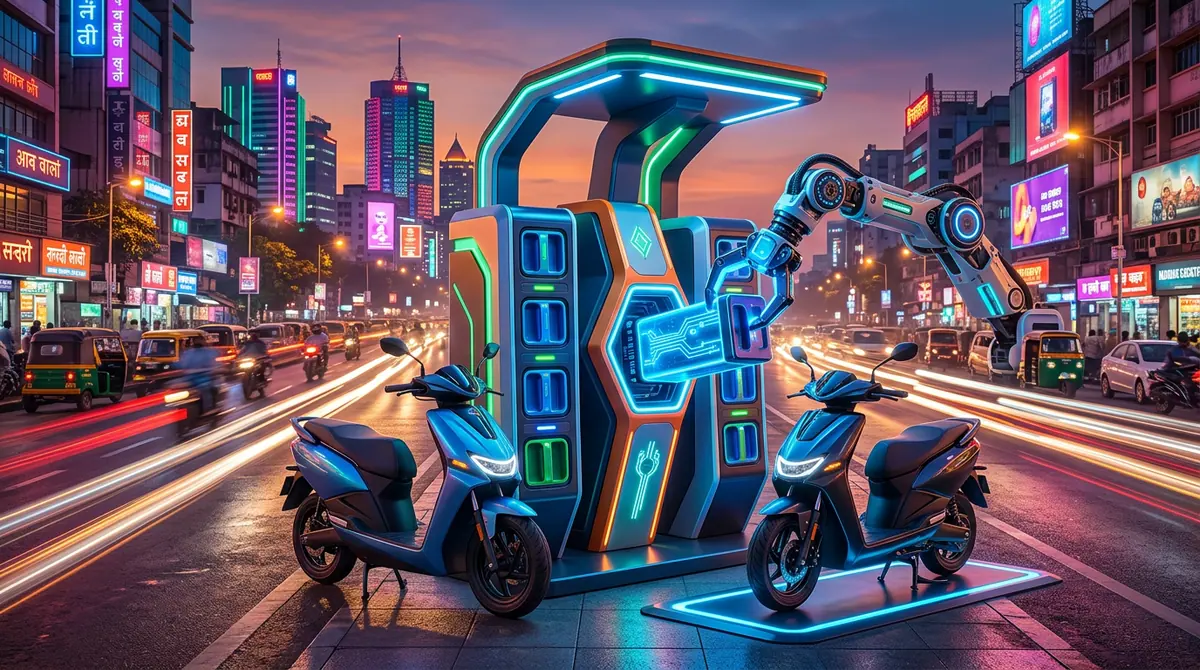
Imagine pulling into a station with a nearly depleted electric scooter and leaving just sixty seconds later with a full battery. You do not plug anything in, you do not wait for a slow chemical reaction to finish, and you certainly do not have time to even finish a cup of coffee. This is not a scene from a science fiction novel (it is the reality unfolding across the streets of India right now). While the West remains largely tethered to the charging cable, a massive infrastructure play is proving that the future of mobility might be modular.
On Tuesday, September 1, 2026, the global automotive giant Magna signaled its unwavering confidence in this vision by leading a $35 million Series A funding round for Yuma, a battery-swapping joint venture. This influx of capital, reported by TechCrunch and Moneycontrol, marks a significant escalation in the race to electrify the world’s most populous nation. By doubling down on swapping, Magna is betting that the key to mass EV adoption is not bigger batteries, but smarter ones.
What is New: Scaling the Infrastructure
This latest investment represents a major shift in the corporate landscape of Yuma. According to reporting by TechCrunch, Magna is increasing its stake in the venture after originally taking a 51 percent share at its inception. This move effectively dilutes the stake of its partner, Yulu, while providing the necessary fuel for a massive network expansion. This is not just a pilot program anymore (it is a full-scale industrial rollout). Data from the company’s own internal updates shows that Yuma has already facilitated a staggering 35 million battery swaps across 2,000 stations in 17 different cities.
Context: How Battery Swapping Works
For those new to the concept, battery swapping decouples the vehicle from the battery. Instead of owning the expensive lithium-ion pack inside your scooter or rickshaw, you essentially subscribe to a battery service. When your charge is low, you visit a specialized kiosk, slide out your empty battery, and pop in a fresh one. This eliminates the two biggest hurdles for EV buyers: the high upfront cost of batteries and the long wait times associated with traditional charging stations.
Why it Matters: Solving the Urban Mobility Puzzle
The implications of this $35 million bet extend far beyond the borders of India. As urban centers become more crowded, the ability to support millions of electric two-wheelers and three-wheelers becomes a logistical nightmare if every driver needs a dedicated plug. Inc42 notes that this expansion capital is specifically aimed at strengthening Yuma's network, ensuring that drivers are never more than a few minutes away from a fresh power source. This is particularly vital for the gig economy (delivery drivers and couriers who cannot afford to sit idle for forty minutes while a battery fast-charges).
Furthermore, this model reduces the strain on the power grid. Charging stations can trickle-charge batteries during off-peak hours and have them ready for the morning rush, providing a natural buffer for the electrical infrastructure of growing cities. As reported by Moneycontrol, this strategy is what makes the Indian market a perfect laboratory for the future of global urban transport.
What to Watch Next: The Global Ripple Effect
While the focus today is on India, Magna’s commitment suggests a broader ambition. As the technology matures and the logistics of managing thousands of modular battery packs are perfected, expect to see similar models emerge in Southeast Asia, Africa, and eventually, the densely packed cities of Europe and North America. The real test will be standardization: if different manufacturers can agree on a universal battery size and connector, the swapping station could become as ubiquitous and convenient as the neighborhood vending machine.
According to TechCrunch, Magna had already committed $77 million to its India-based mobility bets back in 2022, including $52 million specifically for this joint venture. This consistent flow of capital suggests that the industry's heavy hitters are no longer asking if battery swapping works; they are simply asking how fast they can build it. The era of the long wait is ending, and the era of the instant swap has officially arrived.
Discussion (0)
Commenting as
No comments yet. Be the first to share your thoughts!
The discussion could not be loaded. Please refresh the page.
EdTech specialist and former computer science educator