
Your Office Is About to Get Eerily Quiet: The Rise of the Whisper-Mode AI
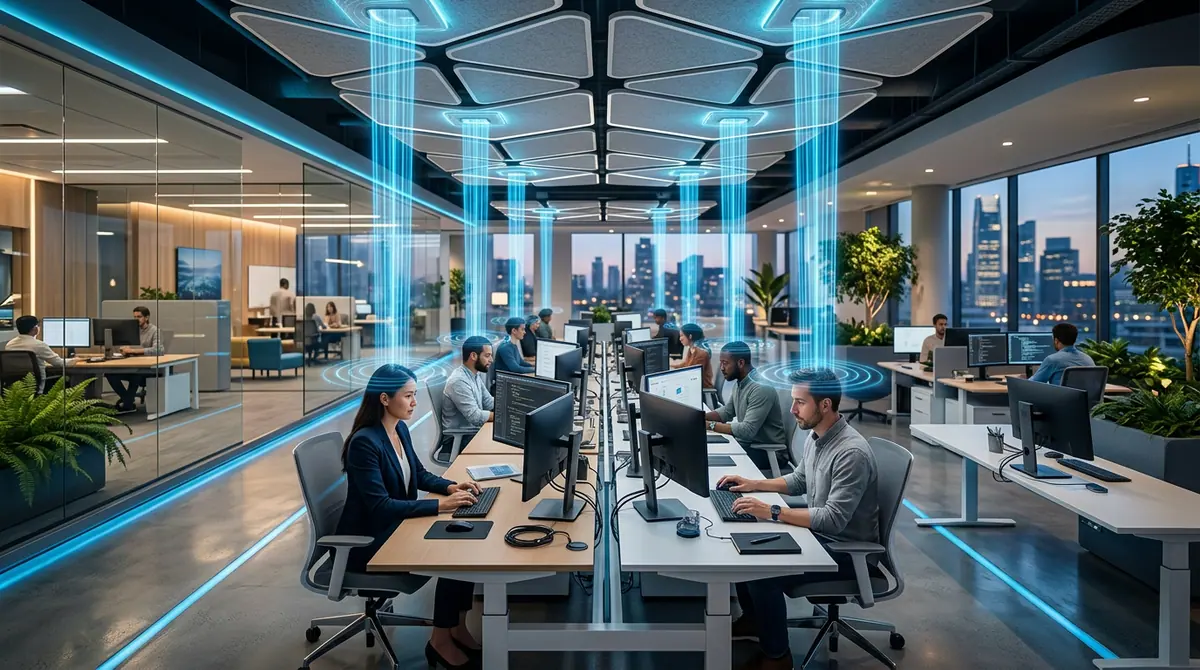
New directional audio and AI-powered 'whisper zones' are turning chaotic open offices into sanctuaries of focus. Discover how sound-beam technology is changing the way we work.
Key takeaways
- Directional audio and beamforming speakers are being integrated into office designs to create 'private sound zones' in open-plan spaces.
- Major tech players like Google, Sony, and Microsoft are piloting 'WhisperPods' and 'Sound Bubbles' to improve productivity and reduce noise pollution.
- The market for spatial audio hardware is expected to reach $1.2 billion by 2028, driven by corporate adoption.
- Significant privacy concerns remain, with critics and regulators warning about the potential for 'audio surveillance' via always-on microphones.
The End of the Open Office Acoustic Nightmare
Imagine walking into a bustling city office at peak hour, expecting the usual cacophony of ringing phones, clacking keyboards, and loud coffee-break debates, only to find it sounding like a library at midnight. This is not a scene from a science-fiction film; it is the reality currently being built by the world's leading tech innovators. According to a recent report by TechCrunch, a new wave of office technology integrating directional audio and whisper-mode artificial intelligence is set to transform the modern workspace into a series of invisible, private sound zones.
For years, the open-plan office has been criticized for being a productivity killer, with noise pollution cited as a primary reason for employee burnout. However, the latest breakthroughs in beamforming speakers and ultrasonic microphones are promising to fix what traditional architecture could not. By focusing sound waves with laser-like precision, these systems allow two colleagues to have a private conversation in the middle of a crowded room without anyone else hearing a single word.
What Changed: From Noise Cancellation to Sound Shaping
The innovation represents a significant leap from the passive noise-canceling headphones we have grown used to. While older tech relied on blocking sound out, this new generation of hardware, such as the directional speakers demoed by firms like Audfly, actually controls where sound travels. According to a VentureBeat analysis published in April 2026, we are moving into an era of spatial audio hardware that is projected to grow into a 1.2 billion dollar market by 2028. This shift is being driven by a Gartner report predicting that 40 percent of major corporations will adopt some form of directional audio tech within the next two years.
Context: How Directional Audio Works
Directional audio uses arrays of tiny speakers to fire sound waves that stay narrow and focused, similar to how a flashlight beam focuses light. Unlike traditional speakers that broadcast sound in all directions, these beamforming systems ensure that audio is only audible to the person standing in a specific spot. When paired with AI noise-cancellation software, such as the tools developed by Krisp.ai, the system can isolate a human voice and 'beam' it directly to a recipient while keeping the surrounding environment silent.
The Tech Titans Enter the Whisper Race
The race to dominate the quiet office is already heating up among the giants of Silicon Valley. Bloomberg reported on May 10, 2026, that Google has begun piloting something called WhisperPods in its New York City offices. These pods, developed in partnership with Point Source Audio, use localized sound fields to create private meeting spaces without the need for physical walls. Meanwhile, researchers at Sony have been testing their own Sound Bubble prototype in Tokyo, according to a feature in the MIT Technology Review. This system creates a personal acoustic zone around a user's desk, effectively muting the rest of the office while allowing the user to hear their own notifications and calls perfectly.
Even software-heavy companies are getting involved. Microsoft recently updated its Viva Insights platform to integrate whisper AI, a move that Reuters reports helped boost the company's stock by 2 percent. This software helps manage the 'acoustic load' of a team, suggesting when employees should switch to whisper mode based on the noise levels of the room.
Why It Matters: The Future of Collaboration
The implications for the future of work are profound. This technology solves the primary tension of the post-hybrid era: the need for collaborative physical spaces versus the need for deep, focused work. If a worker can sit in a shared space and still enjoy the privacy of a home office, the 'forced return' to corporate headquarters becomes much more palatable. This tech could potentially end the era of 'Zoom fatigue' in the office, where employees sit at their desks wearing heavy headsets all day just to find some peace.
What to Watch Next
- Privacy and Surveillance: Not everyone is convinced this is a utopian development. A report from Wired warns of audio surveillance risks, noting that the 'always-on' microphones required for these systems could enable unauthorized data harvesting.
- Regulatory Pushback: The European Union is already looking into these technologies under GDPR guidelines, specifically eyeing hardware like Cisco Webex Rooms for potential privacy violations.
- The Design Counter-Argument: Some experts believe this is a technical band-aid for a human problem. Workplace expert Dr. Libby Sander recently told Forbes that whispers do not fix the burnout caused by rigid office cultures.
- Mainstream Integration: Expect to see these beamforming speakers move from high-end corporate suites into consumer-grade monitors and furniture by late 2027.
A Silent Revolution
The office of 2026 is becoming a place where sound is no longer a public utility but a private luxury. While the technology promises to reclaim our lost focus and turn the chaotic open office into a sanctuary of productivity, the social costs of a whisper-filled world remain to be seen. Whether we are entering a new age of efficiency or a silent era of increased surveillance, one thing is certain: the loud, clattering office of the past is finally being muted. As we look toward the future, the most valuable commodity in any workspace will not be the fast internet or the free coffee; it will be the silence.
Sources (8)
Discussion (0)
Commenting as
No comments yet. Be the first to share your thoughts!
The discussion could not be loaded. Please refresh the page.
Digital transformation writer and startup advisor


