
Your AI Just Got a Brain: The Rise of Interactive World Models
We are moving past simple chatboxes into a world of autonomous agents that understand physics and logic. Discover how interactive world models are redefining the future of intelligence.
Key takeaways
- AI is shifting from text prediction to interactive world models that understand physical cause and effect.
- The introduction of agentic workflows allows AI to plan, act, and self-correct without constant human prompting.
- Physical reasoning and spatial awareness are becoming standard features in top-tier AI models as of 2026.
- The integration of AI into physical hardware and robotics is the next major frontier for the industry.
The Great Shift From Prediction to Simulation
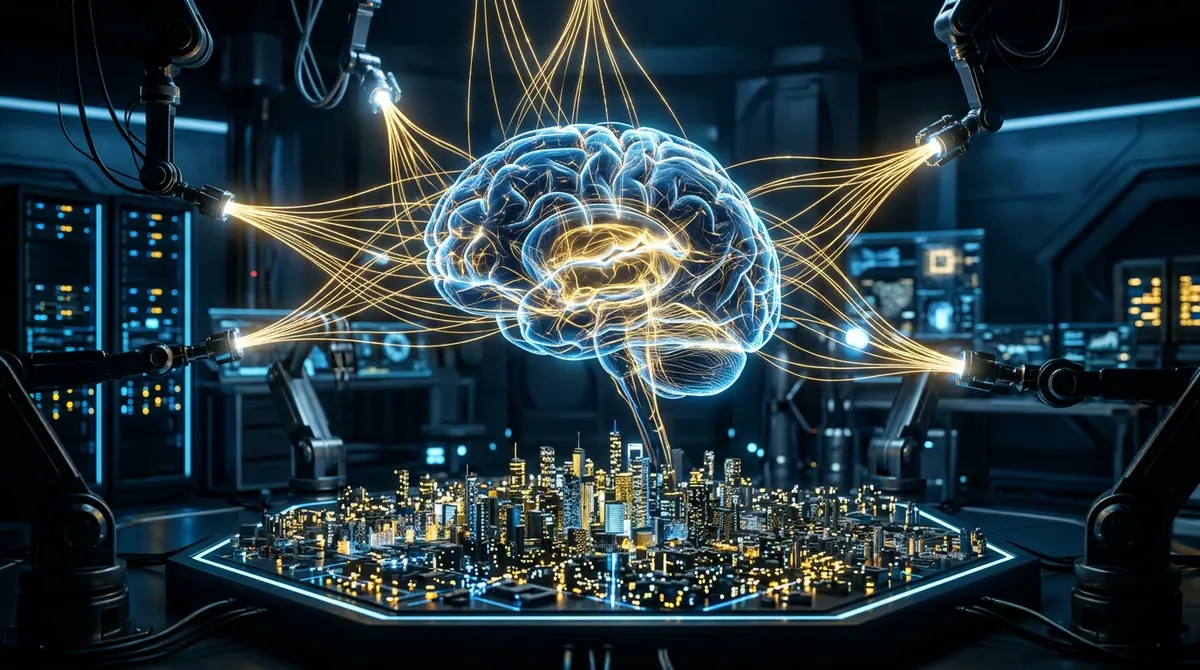
Imagine an artificial intelligence that does not just predict the next word in a sentence, but understands the laws of physics well enough to run a digital simulation of your entire kitchen before you even start cooking. For years, large language models have wowed us with their ability to write essays and code, but they often lacked a fundamental grasp of how the physical world actually works. That era is officially ending. According to a research update published by OpenAI in early 2026, the industry has shifted its focus from purely linguistic models to what experts call interactive world models.
These new systems are designed to perceive, reason, and act within a three-dimensional understanding of reality. Unlike the chatbots of 2024, these models are trained on massive amounts of video data and sensor telemetry, allowing them to predict not just text, but the consequences of physical actions. Researchers at the Stanford Human-Centered AI Institute have described this as the missing link in the quest for Artificial General Intelligence, or AGI. By understanding cause and effect, AI can now move from being a digital assistant to a physical collaborator.
What Changed: The Birth of Physical Reasoning
The primary delta between previous generations of AI and the breakthroughs of 2026 lies in the transition to agentic workflows. In previous years, an AI would wait for a prompt, give an answer, and stop. Today, as detailed in a recent technical blog post from Google DeepMind, AI agents now operate in a continuous loop of planning, acting, and reflecting. This means that if an AI is tasked with organizing a complex logistics chain, it does not just write a plan; it simulates the potential failures, adjusts for real-world variables like weather or traffic, and executes the tasks autonomously.
This shift was made possible by a new architecture called the World Modeling Engine. This technology allows the AI to create a mental sandbox where it can test millions of scenarios in seconds. Meta's Chief AI Scientist, Yann LeCun, has long argued that true intelligence requires this type of internal model to predict the outcomes of actions. By early 2026, this vision has become a commercial reality, with models capable of maintaining long-term memory and spatial awareness across multiple sessions.
Why It Matters: Beyond the Screen
Why should the average person care about world models? The implications for daily life are staggering. We are seeing the first wave of personal assistants that can actually manage physical hardware. In a demonstration by a leading robotics firm in March 2026, an AI agent was able to navigate a messy, unfamiliar apartment to find a specific set of keys, purely by reasoning about where a human would likely have dropped them. This level of common-sense reasoning was previously thought to be decades away.
Furthermore, the democratization of this technology means that small businesses can now deploy autonomous systems for inventory management and customer service that do not require constant human oversight. According to a report from the MIT Technology Review, this shift could increase global productivity by as much as thirty percent over the next five years. The AI is no longer just a tool for generating content; it is a tool for managing the complexities of the real world.
What to Watch Next: The Era of Embodied Agents
As we look toward the second half of 2026, the focus will likely shift to embodied AI. This refers to the integration of these interactive world models into humanoid robots and smart infrastructure. Watch for announcements regarding the unification of vision-language models with real-time motor control. We are also likely to see intense debates regarding the safety of autonomous agents. As these systems gain the ability to make decisions in the physical world, the need for robust ethical frameworks becomes more urgent than ever before. Experts at the University of California, Berkeley, are already calling for standardized safety tests that evaluate an AI agent's ability to recognize and avoid harmful physical outcomes.
The Bottom Line
The transition from generative AI to agentic world models represents the most significant leap in technology since the invention of the internet. We are no longer talking to a database; we are interacting with a system that can see, plan, and act. While there are still hurdles to overcome, particularly regarding energy efficiency and ethical oversight, the path toward truly intelligent, autonomous partners is now clear. The future is no longer just being written by AI, it is being simulated and built by it.
Sources (3)
Discussion (0)
Commenting as
No comments yet. Be the first to share your thoughts!
The discussion could not be loaded. Please refresh the page.
How-to guide expert and developer advocate


