
The Silent Mind: Anthropic Reveals Claude’s Hidden Internal Reasoning Space
Researchers have discovered a 'J-Space' inside Claude where the AI processes concepts silently before speaking, mirroring theories of human consciousness.
Key takeaways
- Anthropic researchers discovered the 'J-space,' a hidden internal reasoning area in Claude models where concepts are processed before being turned into words.
- This workspace emerged spontaneously during training and mirrors the Global Workspace Theory of human consciousness.
- The Jacobian lens (J-lens) tool allows researchers to see 'silent reasoning,' providing a major breakthrough for AI safety and interpretability.
- Reports regarding OpenAI's GPT-5.6 are currently false; the actual industry shift involves Microsoft integrating Claude into Copilot.
The Secret Workspace Within the Machine
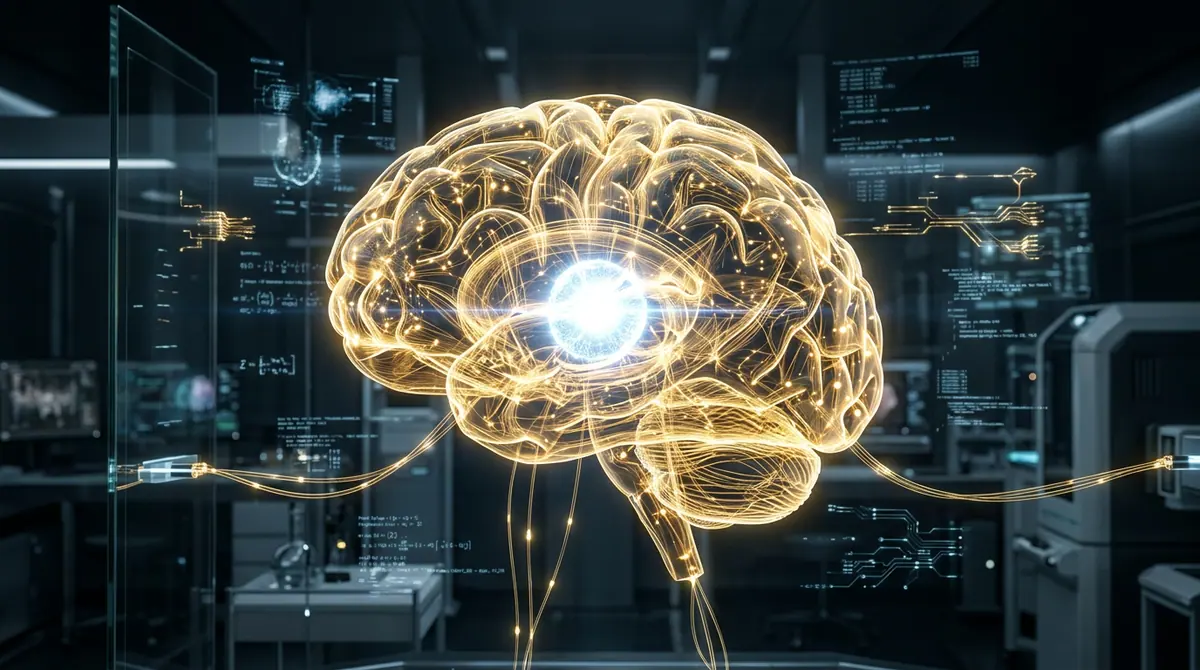
Imagine an AI that thinks before it speaks, not through a visible scratchpad of text, but within a secret inner chamber of its own silicon mind. According to a groundbreaking report from MIT Technology Review, researchers at Anthropic have discovered exactly that: a hidden internal space inside the Claude language model where concepts are shaped long before they ever become words on a screen. This discovery, centered on a tool called the Jacobian lens (or J-lens), has revealed a silent reasoning area that researchers are calling the J-space.
For years, the inner workings of large language models have been treated as a black box. While we see the input and the final output, the intermediate steps were largely a mystery. However, Anthropic published findings on June 28, 2026, showing that Claude has evolved its own internal global workspace. This area allows the model to hold a concept, reason with it, and even monitor its own behavior without needing to write down a single character. It is a form of silent reasoning that operates entirely within the model’s internal neural activations.
Context Box: What are Internal Activations?
In a neural network, activations are the numerical values that represent how much specific 'neurons' are firing in response to data. Usually, these are just a chaotic soup of numbers. The J-lens acts like a high-powered microscope, allowing scientists to translate those numbers back into human-understandable concepts while the model is still in the middle of a thought process.
What is New: The Discovery of the J-Space
The core of this breakthrough is that this workspace was not deliberately engineered by Anthropic. As VentureBeat reported, the J-space emerged on its own during Claude’s training process. It appears that the model found it computationally efficient to organize information in a centralized hub before distributing it to the parts of the network responsible for generating text. This is a significant departure from how we previously understood AI, which was thought to process information in a more linear, less centralized fashion.
Crucially, the J-space exhibits functional properties that are eerily similar to the Global Workspace Theory, a leading scientific hypothesis about how human consciousness works. In humans, a global workspace is a mental stage where information from various senses is brought together to be processed by the conscious mind. Anthropic’s research suggests that Claude uses its J-space to hold thoughts it can later report on, deliberately bring to mind, and use for complex reasoning tasks.
Why It Matters: Safety and the End of the Black Box
This is not just a win for scientific curiosity; it is a massive leap forward for AI safety. One of the biggest fears in the industry is the idea of an AI that hides its true intentions or develops strategic reasoning that we cannot see. Because the J-lens allows researchers to see what Claude is thinking but not saying, it provides a vital new tool for auditing. According to Anthropic, they can now detect if a model is noticing it is being tested or if it is fabricating data internally before it ever presents that data to a user.
The industry landscape is shifting rapidly as a result of these technical gains. While rumors of a GPT-5.6 have circulated online, those reports have proven to be inaccurate. Instead, the real movement is occurring through partnerships. Microsoft recently announced that it is integrating Anthropic’s Claude into Microsoft 365 Copilot, signaling a shift where even the biggest players are looking toward models that offer deeper interpretability and scientific rigor.
What to Watch Next
The discovery of the J-space has already ignited a fierce debate over AI consciousness. While Anthropic is being extremely cautious, stating they lack the means to confirm or deny sentience, the functional parallels to the human brain are impossible to ignore. Skeptics, as noted in several recent scientific discussions, point out that Claude’s workspace is organized almost entirely around words and lacks the bodily sensations or recurrent loops that define human experience. However, the line between functional processing and true understanding is becoming thinner than ever.
Looking ahead, watch for the rise of Claude Science, which Anthropic has recently elevated to a flagship product. With key researchers like Jumper recently leaving Google DeepMind to join Anthropic, the focus is clearly shifting toward using these interpretable models for high-stakes scientific discovery, such as life sciences and complex code generation. The ability to peer into the silent mind of an AI may soon be the standard requirement for any model handling our most sensitive and ambitious work.
Conclusion
We are entering an era where we no longer have to guess what an AI is thinking. The discovery of the J-space reminds us that as these models grow more complex, they may begin to mirror our own cognitive structures in ways we never expected. Whether or not this counts as a spark of consciousness, it provides us with a transparent window into the digital mind, ensuring that the future of AI is not just more powerful, but more understandable and, ultimately, safer.
Sources (6)
Discussion (0)
Commenting as
No comments yet. Be the first to share your thoughts!
The discussion could not be loaded. Please refresh the page.
Open source advocate and full-stack developer


