
The Robot in Your Kitchen: Why 2026 is the Year Humanoids Finally Moved In
Humanoid robots are no longer confined to factory floors. New breakthroughs in physical AI are bringing general-purpose assistants into our homes and changing daily life forever.
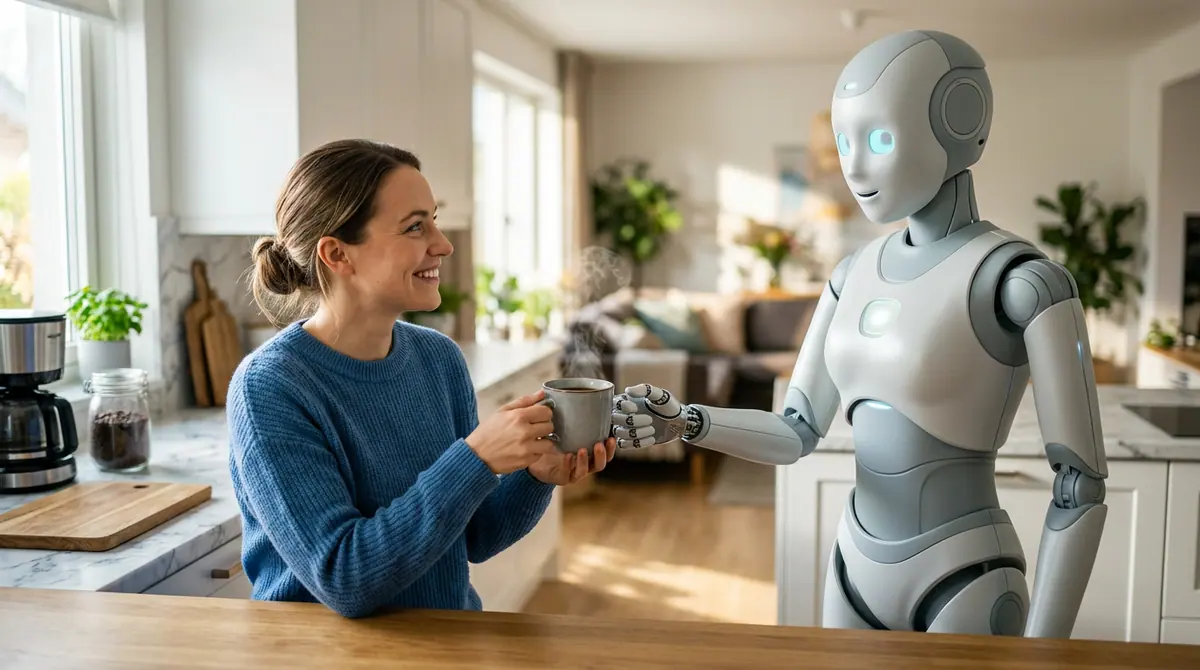
Key takeaways
- General-purpose humanoid robots have officially moved from industrial settings to residential consumer markets as of mid-2026.
- The core technological breakthrough is 'Embodied AI,' which allows robots to learn complex physical tasks through visual observation rather than rigid programming.
- The emergence of 'Universal Foundation Models' has allowed robots to handle unpredictable domestic environments and edge cases effectively.
- Future developments will likely focus on a software ecosystem for physical tasks and the regulatory challenges regarding domestic data privacy.
The Era of Physical Intelligence Has Arrived
Imagine waking up to the smell of fresh coffee, not because you set a digital timer, but because your household assistant noticed you stirring and decided to start the brew. This is no longer a scene from a science fiction film. According to a June 2026 report from Bloomberg Technology, the first wave of general-purpose humanoid robots has officially transitioned from pilot programs in warehouses to the consumer living room. For decades, we have interacted with AI through glowing rectangles in our pockets; today, AI has finally found its legs, arms, and a sense of touch.
This shift represents the most significant leap in personal technology since the introduction of the smartphone. While early iterations of robotics were limited to single-task machines like vacuum discs or automated lawnmowers, the new generation of "Embodied AI" uses multimodal large language models to understand the physical world in real time. Researchers at the Stanford Vision and Learning Lab published findings earlier this spring showing that these machines can now learn complex domestic tasks, such as folding laundry or loading a dishwasher, simply by watching a human perform the action once.
Context: From Chatbots to Physical Beings
To understand where we are, we must look at how far we have come. Just three years ago, the world was mesmerized by chatbots that could write essays or code software. However, those models were "disembodied," meaning they had no way to interact with the physical environment. The innovation we are seeing in 2026 is the marriage of those cognitive brains with advanced hardware. This includes high-torque actuators that mimic human muscle movement and tactile sensors that allow a robot to pick up a fragile egg without breaking it. The transition from digital AI to physical AI is what industry experts call the "Great Embodiment."
What Changed: The Breakthrough in Generalization
The primary hurdle for robotics has always been "edge cases," those unpredictable moments like a dog running across the floor or a chair being moved out of place. Previously, robots would freeze when faced with a situation not found in their programming. According to a technical deep dive published by NVIDIA in May, the introduction of "Universal Foundation Models for Robotics" has solved this. These models are trained on billions of hours of video data, allowing robots to generalize their knowledge. If a robot knows how to wipe a table, it can now figure out how to wipe a counter or a window without needing a software update. This ability to adapt to new environments is the specific delta that allowed companies like Figure AI and Tesla to begin shipping units to residential customers this month.
Why It Matters: Solving the Time Poverty Crisis
The implications for the average household are staggering. The U.S. Bureau of Labor Statistics recently noted that the average American spends over two hours a day on household chores. The introduction of affordable, lease-based humanoid assistants could reclaim that time for families. Beyond mere convenience, there is a profound social impact for the elderly. A white paper from the World Health Organization suggests that humanoid assistants are already reducing the burden on assisted living facilities by helping seniors with mobility, medication reminders, and basic companionship. This technology is not just about luxury; it is becoming a critical tool for managing an aging global population.
What to Watch Next: The Body-Sharing Economy
As we look toward the end of 2026 and into 2027, the focus is shifting from hardware to software ecosystems. We should expect the rise of an "App Store for Physical Tasks." Instead of downloading a game, you might download a "Gourmet Chef" module created by a Michelin-starred cook or a "Physiotherapist" module to help with injury recovery. Additionally, the industry is bracing for a heated debate over privacy. As these robots use high-resolution cameras to navigate our homes, the question of who owns that data (and where it is stored) will likely lead to new federal regulations. Experts at MIT Technology Review predict that "Privacy-First Robotics" will be the next major marketing frontier as consumers demand that their robot assistants stay offline as much as possible.
The journey from the first industrial robot to a companion in the kitchen has been long and fraught with challenges. Yet, as we stand here in June 2026, it is clear that the boundary between the digital and physical worlds has finally dissolved. The robot in your kitchen is not just a machine; it is a testament to human ingenuity and the beginning of a new chapter in how we live, work, and interact with the world around us.
Sources (3)
Discussion (0)
Commenting as
No comments yet. Be the first to share your thoughts!
The discussion could not be loaded. Please refresh the page.
Mobile app developer and UX design writer


