
The Invisible Wearable: Why Google is Finally Killing the Smartwatch Screen
Google’s new screenless Fitbit Air signals a massive shift in health tech. Is the era of wrist-based notification fatigue finally coming to an end?
Key takeaways
- Google's Fitbit Air ditches the screen in favor of Gemini AI and haptics to reduce screen addiction.
- The standalone Fitbit app will be replaced by a unified Google Health app by Q4 2026.
- Early tests show the device achieves 95% sleep tracking accuracy, positioning it as a clinical-grade health tool.
- The device represents a shift toward 'ambient health' where technology monitors users without requiring constant visual attention.
The Era of Digital Minimalism Begins
For the last decade, we have been told that the future of health involves more screens, more notifications, and more bright lights strapped to our wrists. But Google is about to bet $149 that we were all wrong. At the Google I/O event held on April 28, 2026, the tech giant unveiled the Fitbit Air, a device that marks a radical departure from the glowing rectangles of the past. It is a screenless wristband that prioritizes silence, presence, and sophisticated ambient intelligence over flashy pixels.
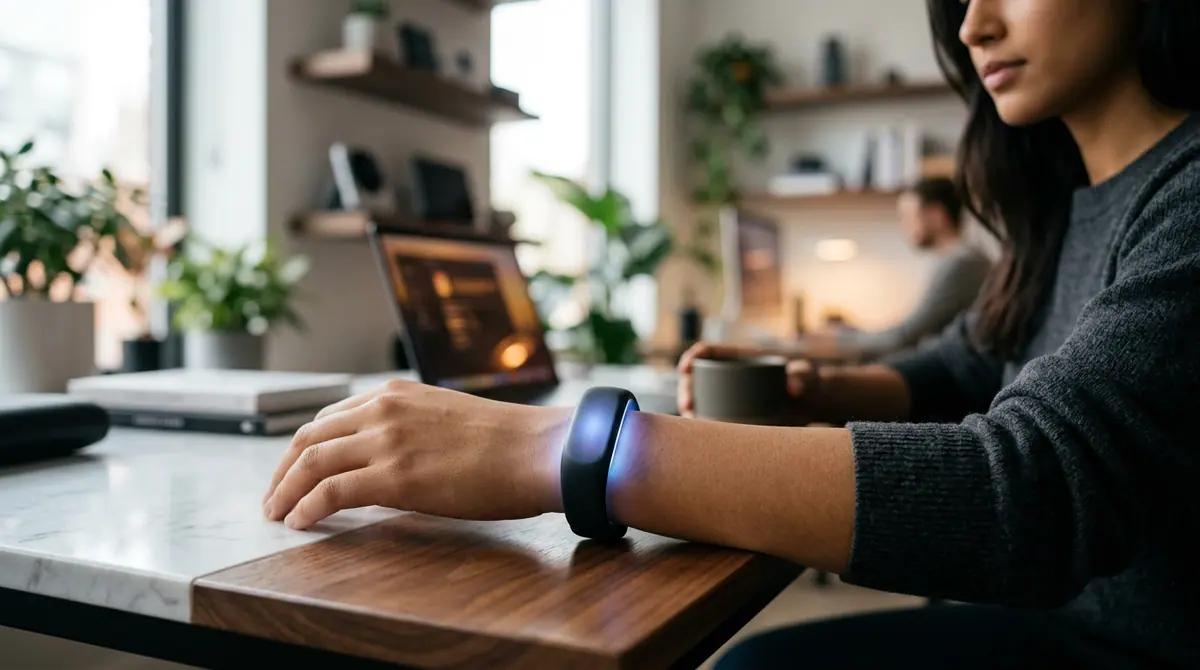
The Fitbit Air is not a smartwatch in the traditional sense. It is a sleek, sensor-rich band that communicates through haptics, voice via Gemini AI, and deep data integration. According to a report by Ars Technica, the device is Google’s primary weapon in a new war against screen addiction. By stripping away the display, Google aims to provide users with the biometric tracking they crave without the constant distraction of incoming texts or emails. It is a bold move in a market currently dominated by the Apple Watch, which holds a massive 50 percent market share.
What Changed: From Visuals to Voice
The biggest shift is the move from a visual interface to an invisible one. While traditional wearables force you to squint at tiny icons, the Fitbit Air relies on Gemini AI to deliver health insights. If your heart rate is elevated or your sleep was poor, you won't see a chart on your wrist. Instead, you can ask the device for a summary, or it will provide subtle haptic nudges to guide your behavior. This transition represents a fundamental pivot in Google's wearable strategy, moving from a secondary phone on the wrist to a dedicated health companion.
The Power of Ambient Health
The device is packed with advanced biosensors designed for high-fidelity heart rate and sleep tracking. In fact, early testing shared by CNET indicates that the Fitbit Air achieved a staggering 95 percent sleep accuracy rate, rivaling clinical-grade equipment. The hardware is only half the story, however. The company announced in a blog post on April 28 that the standalone Fitbit app will be officially retired by the fourth quarter of 2026, to be replaced by a unified Google Health app. This new ecosystem will merge data from Pixel devices, Fitbit hardware, and third-party sources into one centralized AI-driven dashboard.
Wired reported on April 29 that the Fitbit Air will also integrate seamlessly with Google Health Connect, allowing for easy sharing of biometric data with medical providers through Electronic Health Records (EHR). This moves the device out of the realm of fitness gadgets and into the world of genuine medical tools.
Why It Matters: Reclaiming Our Attention
Why would anyone pay $149 for a device that doesn't even tell the time at a glance? The answer lies in mental health. The Verge noted in an analysis on April 30 that while some may question the price point compared to the screen-rich competition, the value is in the lack of interruption. We are living through a period of peak notification fatigue. The Fitbit Air offers a way to stay connected to our bodies without being tethered to the digital world. It is a tool for people who want the data of an Oura Ring but prefer the wrist-based form factor of a traditional tracker.
What to Watch Next
The screenless revolution is already attracting competition. As Google prepares to ship the Fitbit Air in June 2026, Samsung has already teased a similar screenless Galaxy Ring 2, as reported by Engadget earlier this month. Furthermore, market analysts at IDC predict that Google could sell as many as 10 million units of this new screenless category by 2027, suggesting that the public's appetite for less intrusive technology is growing.
As we look toward the future, the success of the Fitbit Air will depend on whether Gemini AI can truly replace a screen. If Google can prove that a voice-and-haptic interface is more intuitive than a touch-screen, we may be witnessing the beginning of the end for the traditional smartwatch. The goal is no longer to keep us looking at our wrists, but to help us look at the world around us while our technology works quietly in the background.
Sources (12)
Discussion (0)
Commenting as
No comments yet. Be the first to share your thoughts!
The discussion could not be loaded. Please refresh the page.
Robotics and automation industry analyst


