
The Invisible Made Visible: How AI is Capturing the First Movie of a Black Hole
Astrophysicists are using OpenAI’s Codex to simulate extreme gravity and plasma, aiming to release the first moving image of a black hole by 2027.
Key takeaways
- AI is being used to bridge the gap between complex theoretical physics and the code required for black hole plasma simulations.
- The Event Horizon Telescope team aims to produce the first moving image of a black hole by 2027 with AI assistance.
- AI is transitioning into a domain-specific infrastructure tool, moving beyond generic chat to specialized roles in science and finance.
- The move toward multi-cloud distribution (e.g., Oracle) is making high-end AI models more accessible to large-scale enterprise and research projects.
Capturing the Heart of Darkness
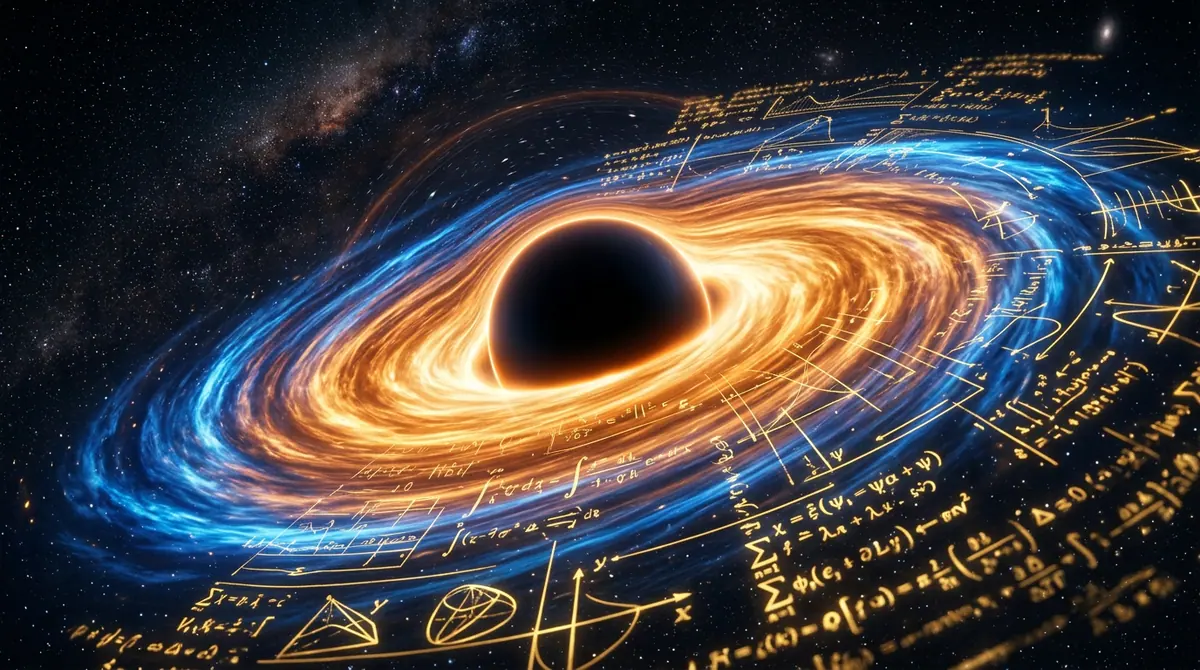
In 2019, the world stood still as the Event Horizon Telescope (EHT) revealed the first ever image of a black hole, a glowing ring of fire surrounding a bottomless void. Now, we are standing on the precipice of an even greater discovery. According to a recent announcement by OpenAI, computational astrophysicists are currently using the AI model Codex to help capture the first moving image of a black hole, a feat they hope to achieve by 2027. This represents a monumental shift from static photography to cinematic physics, where AI acts as the bridge between raw mathematical theory and visual reality.
The challenge of simulating a black hole is not merely an artistic one; it is a battle against the most extreme physics in the universe. Scientists must model hot plasma, light transport, and general relativity in environments where gravity is so strong that even light cannot escape. Traditionally, this required years of meticulous, error prone coding in languages like Fortran and Python. However, Chi-kwan Chan, a researcher working with the EHT team, is leveraging Codex to accelerate this process. As reported by TechBuzz AI, the goal is not for the AI to understand the physics itself, but to act as a high speed laboratory assistant that can write, refine, and translate the complex code required for these massive simulations.
What Changed: From Static Shadows to Fluid Motion
The primary evolution in this field is the move from modeling a single point in time to simulating the chaotic, fluid motion of plasma around a black hole. In the past, researchers were often limited by the sheer computational bottleneck of writing simulation code. According to a report by the Simons Foundation, newer supercomputer models are becoming increasingly comprehensive by treating light and matter interactions in full general relativity. By using AI to prototype algorithms and test variants faster than manual programming allows, the research team can now iterate on these sophisticated numerical methods with unprecedented speed.
Context Box: The Plasma Challenge
Modeling a black hole requires a deep understanding of accretion disks, the swirling masses of gas and dust that orbit the event horizon at nearly the speed of light. Because this gas is so hot, it becomes plasma, a state of matter where atoms are stripped of their electrons. Simulating how this plasma glows and moves requires solving complex equations of magnetohydrodynamics. It is a field where a single coding error can invalidate months of supercomputer time, making the verification capabilities of AI tools like Codex particularly valuable.
Why It Matters: The Industrialization of Discovery
This breakthrough is not happening in a vacuum. It is part of a broader trend where AI is shifting from a novelty to a foundational layer of scientific and industrial infrastructure. For instance, OpenAI recently noted that enterprises can now access models like Codex through existing Oracle Cloud Infrastructure commitments. This means that the same tools helping astrophysicists visualize the far reaches of space are also becoming available to financial giants like the London Stock Exchange Group (LSEG). As LSEG scales its own trusted AI systems to convert high volume data into market decisions, the underlying theme is clear: AI is becoming the engine that powers the world’s most complex data processing tasks.
The Geopolitics of the Horizon
As AI becomes more integral to scientific and economic power, it has also entered the crosshairs of global influence. A recent OpenAI investigation revealed that PRC linked influence operations have begun targeting US debates over AI policy, including governance and export controls. This highlights that the race to simulate black holes or secure financial markets is also a race for technological sovereignty. In Europe, this has led to a push for a trustworthy AI ecosystem, focusing on risk based regulation to ensure that as we build these powerful tools, they remain transparent and aligned with human rights.
What to Watch Next
- The 2027 Deadline: Watch for interim releases of plasma simulations as the EHT team prepares for the first moving image of the M87 or Sagittarius A* black holes.
- Multi-Cloud Integration: As seen with the Oracle deal, expect more frontier models to be embedded directly into enterprise cloud contracts, making high level AI accessible to researchers and corporations without new procurement hurdles.
- Scientific Validation: Pay attention to how the scientific community develops new standards for verifying AI generated code in peer reviewed research.
A New Window into the Cosmos
The path to 2027 is paved with millions of lines of code, much of which will now be written with the help of artificial intelligence. While the physics remains the domain of human genius, the implementation is being revolutionized by tools that can process the tedious and the complex in seconds. We are no longer just looking at the universe; we are learning to simulate its most violent and beautiful moments in real time. The resulting movie of a black hole will be more than just a visual triumph; it will be a testament to the partnership between human curiosity and machine intelligence.
Sources (5)
Discussion (0)
Commenting as
No comments yet. Be the first to share your thoughts!
The discussion could not be loaded. Please refresh the page.
Senior tech journalist covering AI and emerging technologies


