
The End of Trial and Error: Inside OpenAI’s Near-Autonomous AI Chemist
A new era of medicine has arrived as OpenAI’s GPT-Rosalind moves beyond prediction to actively planning and optimizing complex chemical reactions in the lab.
Key takeaways
- OpenAI's near-autonomous AI chemist represents a shift from predictive AI to agentic AI that can plan and optimize complex chemical workflows.
- The GPT-Rosalind architecture, released in April 2026, powers these new capabilities through multi-step reasoning and integration with over 50 scientific databases.
- LifeSciBench has been established as the new industry standard to measure AI performance in complex life science tasks like protein reasoning and genomics.
- Major pharmaceutical companies including Moderna and Amgen are already utilizing these tools through a Trusted Access program to accelerate drug discovery.
The Scientist That Never Sleeps
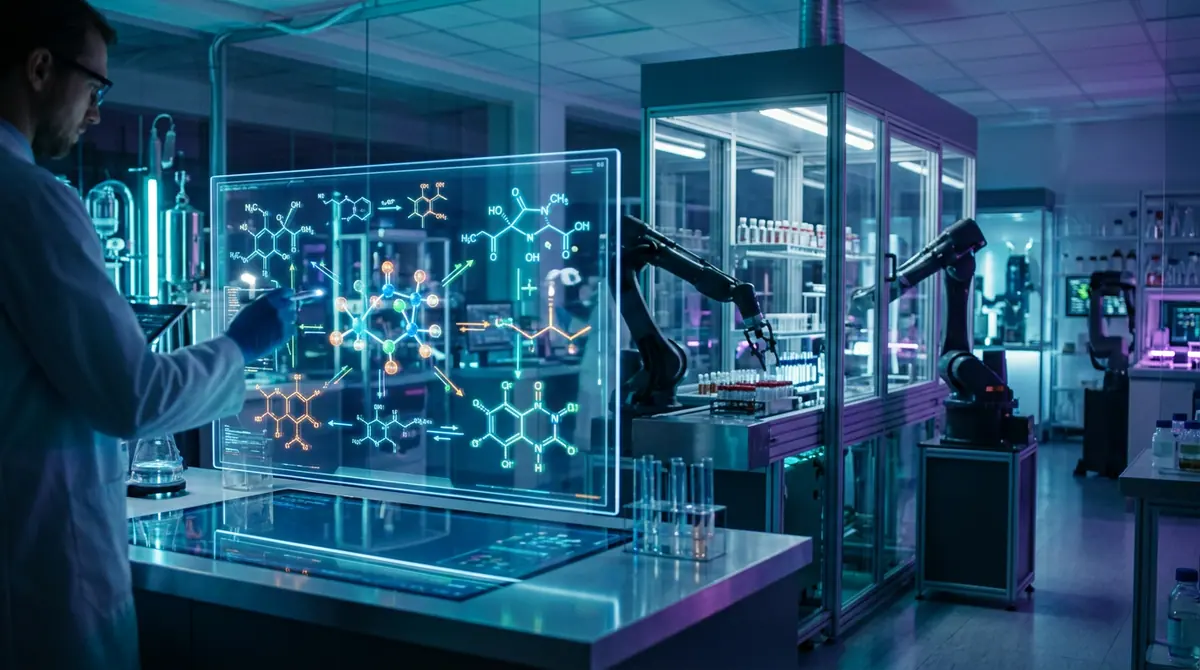
Imagine a scientist who has read every research paper ever published, remembers every molecular structure, and can plan a complex chemical reaction in the time it takes you to pour a cup of coffee. This is no longer the stuff of science fiction. According to a recent announcement from OpenAI, a near-autonomous AI chemist has successfully improved a challenging reaction in medicinal chemistry, marking a pivotal shift in how we discover life-saving drugs. Unlike previous models that merely suggested possibilities, this new system uses advanced reasoning to act as a digital laboratory assistant that can propose, refine, and validate reaction conditions.
Beyond Prediction: The Rise of Agentic AI
For years, the gold standard in biological AI was AlphaFold, a system celebrated for its ability to predict protein structures. However, as noted in reports by DrugPatentWatch, the industry is moving from mere prediction to execution. The new frontier is agent-based AI. OpenAI’s latest breakthrough relies on the GPT-Rosalind architecture, which was officially introduced in April 2026. This model does not just guess what a molecule might look like; it engages in what experts call long-horizon reasoning. It breaks down a complex reaction into individual mechanistic steps, queries over 50 public multi-omics and chemical databases, and simulates outcomes before a single beaker is even touched.
The Shift: What is New
To understand why this is a massive leap forward, we have to look at how science was done just a year ago. In the past, AI tools were passive (they gave researchers ideas, but the researchers had to do all the heavy lifting of planning the workflow). With the arrival of GPT-Rosalind and its Life Sciences Research Plugin, the AI has become active. It can now handle multi-step experimental planning, which includes everything from predicting RNA sequences to identifying the exact conditions needed for low-yield coupling (one of the most difficult hurdles in drug manufacturing). Research published in the Journal of the American Chemical Society and Chemistry of Materials throughout 2025 and 2026 laid the groundwork for this, showing that models using specialized techniques like ChemPrompt Engineering could achieve over 87 percent accuracy in predicting crystallization outcomes.
Why This Matters for You
The implications of a digital chemist are profound, particularly for the cost and speed of healthcare. Medicinal chemistry often stalls on difficult transformations that require months of iterative trial and error. By automating the design-around phase, pharmaceutical giants like Amgen, Moderna, and Novo Nordisk (who are already part of OpenAI’s Trusted Access program) could potentially reduce the time to develop new drugs from years to mere months. For patients, this means faster access to treatments for rare diseases and potentially lower costs for generic medicines as manufacturing routes become more efficient and less wasteful.
LifeSciBench: A New Yardstick for Science
Alongside the AI chemist, OpenAI introduced LifeSciBench to ensure these models are actually as capable as they claim to be. While older benchmarks tested general knowledge, LifeSciBench focuses on real-world scientific capability. It evaluates how well an AI can plan a cloning experiment, correct its own errors in a synthetic pathway, and use digital tools to solve genomics problems. This provides a standardized proof of competence that helps the industry distinguish between a model that can simply chat and one that can actually do science.
What to Watch Next
As we look toward the end of 2026 and beyond, watch for the integration of these life science models with materials science AI. We are moving toward a unified platform where the same intelligence used to design a cancer drug could also create sustainable new plastics or more efficient battery components. Additionally, keep an eye on regulatory bodies like the FDA. As AI-generated experimental data becomes more common, the legal framework for how drugs are approved will need a massive overhaul. We are witnessing the birth of the autonomous laboratory, where the only limit to discovery is the speed at which we can build the robots to keep up with the AI.
A Brave New Laboratory
The transition from AI as a research assistant to AI as a co-pilot in the lab is a historic milestone. While human scientists are still essential for the physical execution and final validation of these experiments, the cognitive heavy lifting of chemistry is being digitized. The near-autonomous chemist is not just a tool; it is a force multiplier for human ingenuity, promising a future where the next medical breakthrough is always just a few prompts away.
Sources (6)
Discussion (0)
Commenting as
No comments yet. Be the first to share your thoughts!
The discussion could not be loaded. Please refresh the page.
Senior tech journalist covering AI and emerging technologies


