
The End of the Specialized Robot: Why Investors Bet $85 Million on Generalists
A new wave of robotics and AI is ditching narrow specialization for extreme versatility. From factory floors to culturally aware AI, technology is finally learning to adapt to the real world.
Key takeaways
- Theker's $85M funding marks a shift from narrow-purpose industrial robots to flexible, general-purpose platforms.
- Indian AI startups like Avataar and Equal AI are succeeding by focusing on cultural awareness and local language needs rather than generic global models.
- AI is increasingly being used as a labor substitute for repetitive manual tasks like call screening and media production in high-volume markets.
- The democratization of high-tech hardware is being driven by both lower-cost robotics and aggressive consumer pricing strategies from major players like Canon.
The Great Pivot Toward Versatile Machines
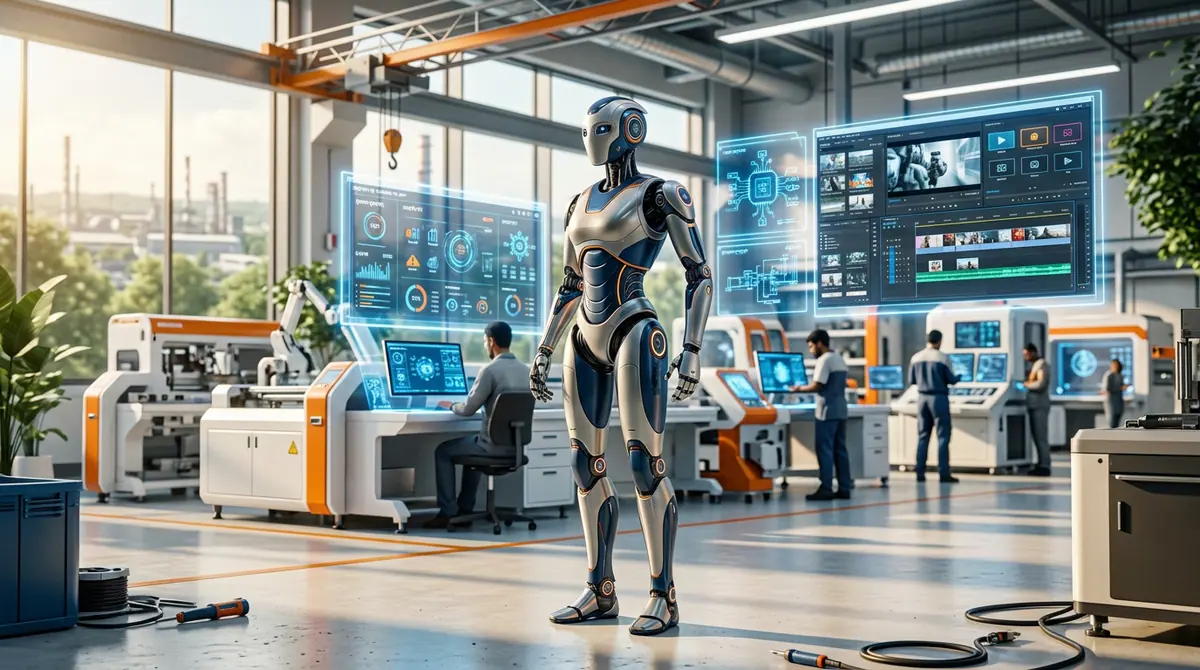
Imagine a factory worker that never needs to be retrained, regardless of whether the task involves sorting microchips or assembling heavy machinery. For decades, the gold standard of industrial automation was the specialized robot: a machine built to do one thing with perfect precision, but incapable of anything else. That era is coming to a definitive end. According to recent financial reports, the robotics startup Theker has secured a massive $85 million investment to develop general-purpose factory robots. Unlike their predecessors, these machines do not specialize in any single task. Instead, they are designed to be flexible, adaptable, and capable of operating across diverse environments without the cost-prohibitive custom integration that has long kept smaller manufacturers away from automation.
The New Paradigm: From Task-Specific to General-Purpose
What changed in the world of robotics to make a generalist robot more valuable than a specialist? Historically, the high speed and reliability of narrow-purpose robots were the only metrics that mattered. However, as supply chains become more volatile and product cycles shorten, the ability to pivot is now more valuable than the ability to repeat. Theker’s $85 million bet reflects a major robotics thesis: the next generation of industrial automation must be as flexible as the human labor it supports. By creating a platform that is not tuned for just one job, companies can deploy these systems across multiple workflows. This reduces the risk for manufacturers who previously feared their expensive automation would become obsolete the moment a product design changed.
Context Box: The Automation Evolution
For the last half-century, industrial robots were largely blind and rigid. They operated in safety cages, following pre-programmed paths to weld or paint with zero deviation. The rise of machine learning and advanced computer vision has enabled a shift toward collaborative robots (cobots) and now, general-purpose platforms. These modern systems can perceive their surroundings and learn new movements, moving us closer to a future where robots are as ubiquitous and easy to deploy as a laptop or a smartphone.
The Local Advantage: Why Cultural Awareness is AIs Next Frontier
The push for versatility is not limited to physical robots. In the digital realm, we are seeing a similar shift away from one-size-fits-all solutions toward hyper-local adaptation. In India, a new wave of AI startups is proving that global models often fall flat when they ignore regional nuances. For example, a report by TechCrunch highlights how the video AI company Avataar is focusing on media generation that is faster, cheaper, and specifically culturally aware. By prioritizing local aesthetics, buying behaviors, and diverse languages, Avataar is moving beyond the generic tools developed in Silicon Valley. This approach is essential in a market where localized content is the primary driver of e-commerce and creator engagement.
Automation as Labor Substitution: Screening the Noise
While some companies focus on visual media, others are using AI to solve more immediate, functional problems. Equal AI recently raised $30 million to tackle a uniquely intense pain point in high-volume markets like India: call screening. In a landscape dominated by voice interactions and plagued by spam, Equal AI acts as a sophisticated digital gatekeeper. This represents a significant shift in how we view AI copilots. Rather than just assisting with writing or coding, these tools are now being used as direct labor substitutes for routine phone interactions. Investors see immense room for these category-specific companies even as massive foundation models from Google and OpenAI continue to dominate the headlines.
Why it Matters: The Democratization of Technology
This shift toward general-purpose hardware and culturally adaptive software matters because it lowers the barrier to entry for both businesses and consumers. When robots do not require custom engineering, small factories can finally compete with global giants. When AI understands local dialects and social norms, it becomes a tool for empowerment rather than just a foreign import. Even in the consumer hardware space, we are seeing a focus on accessibility through value. According to recent data from Tom’s Guide and TechRadar, companies like Canon are increasingly using aggressive discounting strategies, including automatic instant rebates and refurbished gear programs, to keep high-end technology within reach as consumer spending patterns shift. Whether it is a $1,300 discount on a professional camera or an $85 million investment in a robot, the trend is clear: technology is becoming more accessible, more flexible, and more human-centric.
What to Watch Next
In the coming year, watch for the convergence of general-purpose robotics and localized AI. We should expect to see Theker’s flexible hardware integrated with the kind of cultural and linguistic intelligence being pioneered by firms like Avataar and Equal AI. The next breakthrough will not be a robot that does one thing perfectly; it will be a robot that can walk into any factory in any country, understand the local environment, and start working immediately. The era of the specialist is fading; the age of the versatile, culturally aware machine has arrived.
Sources (8)
Discussion (0)
Commenting as
No comments yet. Be the first to share your thoughts!
The discussion could not be loaded. Please refresh the page.
Education technology researcher and policy analyst


