
The End of AI Generalists: Why Thinking Machines is Betting on Specilization
Thinking Machines just launched Inkling, a specialized open-source model that challenges the 'one-size-fits-all' dominance of Google and OpenAI. Is bigger always better?
Key takeaways
- Thinking Machines has launched Inkling, a specialized open-weight model targeting professional verticals like medicine and law.
- The launch signals a shift away from 'one-size-fits-all' general AI models toward more efficient, domain-specific tools.
- Open-weight models provide more transparency and reduce vendor lock-in compared to proprietary systems like GPT-4.
- The broader tech landscape is facing a tension between open-access data and the privatization of valuable information, as seen in both AI and scientific fossil auctions.
The Swiss Army Knife Problem
Imagine trying to perform surgery with a Swiss Army knife or using a bulldozer to plant a single tulip. While these tools are versatile, their lack of precision makes them inefficient for high-stakes tasks. For the last few years, the world of artificial intelligence has been obsessed with the 'everything model,' massive systems like those from OpenAI or Google that try to answer every question from 'how do I bake a cake' to 'quantum physics.' But a major shift occurred this Thursday, July 16, 2026, that could change the trajectory of the industry forever.
Thinking Machines has officially released its first open model, dubbed Inkling. Rather than attempting to be the smartest generalist in the room, Inkling is explicitly positioned against the 'one-size-fits-all' AI paradigm. According to a report by TechCrunch, this strategic pivot suggests that the next wave of technological value will not come from building bigger models, but from building smarter, more specialized ones.
What Changed: The Shift to Specialized Intelligence
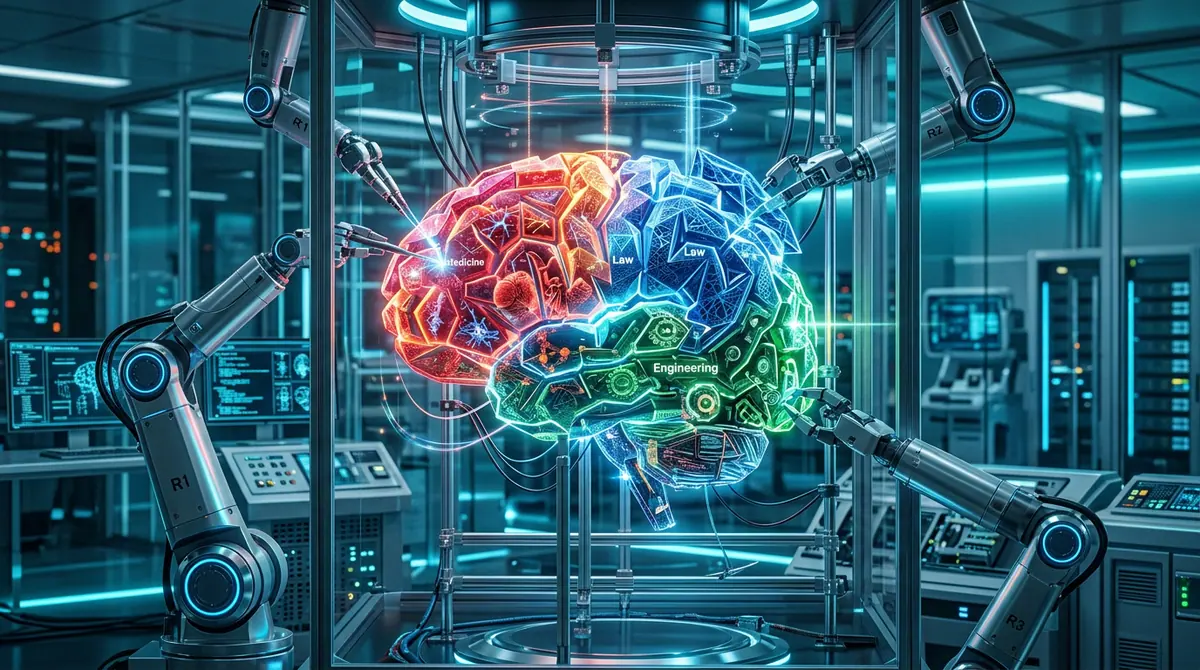
For years, the industry followed 'scaling laws,' the belief that more data and more computing power would inevitably lead to better results. However, Inkling represents a tactical departure. It is a specialized, open-weight model designed for developers to fine-tune for specific professional verticals such as medical research, legal analysis, or complex engineering. While general models are prone to 'hallucinations' and high operational costs, Inkling focuses on efficiency within a narrower scope.
As Thinking Machines noted in their announcement, the overhead of running a giant, multi-purpose model for a task that only requires a fraction of its knowledge is a waste of both time and energy. By releasing the model with 'open weights,' Thinking Machines is allowing companies to look under the hood, a move that directly contrasts with the 'black box' approach favored by major competitors.
Why It Matters
This development matters because it democratizes high-level AI for specialized industries. When a model is too large, only the wealthiest corporations can afford to run it at scale. By focusing on domain-specific efficiency, Thinking Machines is lowering the barrier to entry for startups and niche professionals. According to researchers, this mirrors a broader trend seen with companies like Mistral AI, which have found massive success by offering smaller, more streamlined models for enterprise use.
Furthermore, the move aligns with the growing open-source AI movement. Organizations like the Open Source AI Initiative have long argued that transparency is necessary for safety audits and to prevent 'vendor lock-in,' where a company becomes entirely dependent on one AI provider's proprietary black box. Inkling gives control back to the developers.
Context: What are Open-Weight Models?
For those new to the AI landscape, an 'open-weight' model is similar to open-source software but for the brain of the AI. It means the specific mathematical parameters (the 'weights') that the AI uses to make decisions are publicly available. This allows developers to download the model, run it on their own servers, and customize it without needing to ask the original creator for permission or pay for every single query.
The War for the Future of Data
While Thinking Machines is pushing for open intelligence, other sectors are seeing a tightening of control. In a parallel development that highlights the tension between public knowledge and private wealth, Sotheby’s recently announced an upcoming auction of a T. rex fossil. This has sparked significant backlash from the scientific community. As reported by Ars Technica, paleontologists fear that high-profile fossils are becoming 'trophy assets' for the wealthy, effectively disappearing from the peer-review process and scientific study.
Whether it is the code that powers our AI or the fossils that tell the story of our planet, a central question is emerging: should the most important data in the world be open to all, or sold to the highest bidder? Thinking Machines has clearly taken a side with Inkling, betting that an open, specialized future is more sustainable than a closed, general one.
What to Watch Next
In the coming months, keep a close eye on how Meta and Mistral AI respond to the launch of Inkling. If Inkling gains significant traction in the legal and medical fields, we may see a 'Great Thinning' of AI, where companies stop trying to build the biggest model possible and instead compete to build the most efficient specialized tools. Additionally, watch for potential regulatory shifts; as open-weight models become more powerful, governments may step in to define new safety standards for decentralized AI development.
The era of the AI generalist is not over, but it finally has a formidable rival: the specialist. In a world of digital noise, the most valuable tool may not be the one that does everything, but the one that does exactly what you need.
Discussion (0)
Commenting as
No comments yet. Be the first to share your thoughts!
The discussion could not be loaded. Please refresh the page.
Education technology researcher and policy analyst


