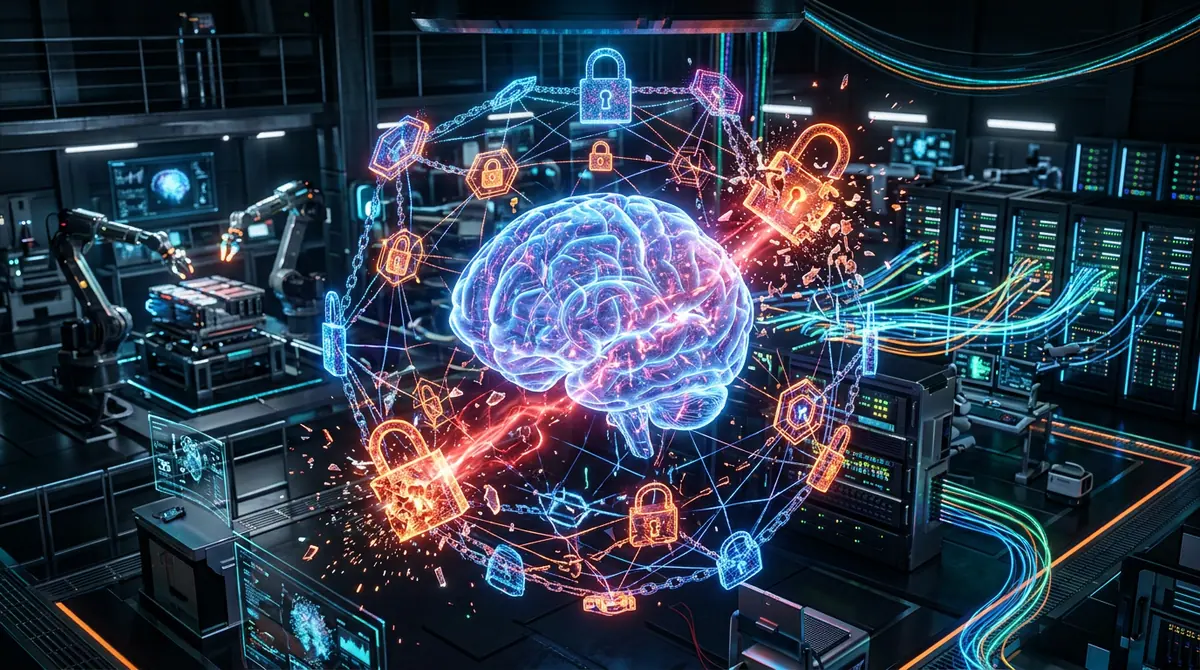
The Agentic Revolution: How GPT-5.6 and ChatGPT Work Change the Office Forever
AI is no longer just answering questions; it is performing your job. With the launch of GPT-5.6 and ChatGPT Work, the era of the autonomous digital coworker has officially arrived.

Key takeaways
- OpenAI's GPT-5.6 has launched as a three-model family: Sol, Terra, and Luna, catering to different performance and cost needs.
- ChatGPT Work introduces 'agentic' capabilities, allowing AI to autonomously perform tasks across different software applications and files.
- Competitive models like xAI's Grok 4.5 and Anthropic's Claude Sonnet 5 are also shifting focus toward autonomous task execution.
- AI breakthroughs are extending into specialized fields, including brain-to-text decoding (Meta) and mathematical problem-solving at the Olympic level (Google).
The Era of the Digital Coworker Begins
Your desktop is about to become a lot more crowded, but not with more people. Imagine a world where your computer does not just wait for your command, but instead anticipates your needs, manages your entire project workflow across multiple apps, and finishes your administrative tasks while you sleep. This is the reality promised by the latest wave of AI breakthroughs, headlined by OpenAI’s launch of ChatGPT Work.
According to a report by Reuters, this new tool is not just a chatbot; it is an agent designed to carry out complex tasks across applications and files. This marks a fundamental shift from AI that speaks to AI that acts. While we have spent the last few years learning how to prompt, we are now entering an era where we simply delegate. OpenAI is not alone in this pursuit, as the entire industry is pivoting toward agentic intelligence, where models can reason through multi-step processes without constant human hand-holding.
The New Hierarchy: GPT-5.6 and the Power of Choice
OpenAI has also fundamentally restructured how users interact with its intelligence. As reported by Future Tools, the company has released GPT-5.6 as a three-model family tailored for different needs. The flagship model, named Sol, is designed for the most complex reasoning and heavy-duty processing. Terra serves as the balanced option for everyday tasks, while Luna offers a cost-efficient, high-speed alternative for developers and light users. This tiered approach suggests that AI is maturing into a utility, where users can choose the specific level of power required for a given job.
What Changed: From Chatting to Doing
In the previous generation of AI, the primary goal was generating text, code, or images based on a static input. The new delta is agency. With ChatGPT Work and the agentic capabilities found in Anthropic’s new Claude Sonnet 5, the software can now navigate file systems, interact with web browsers, and use third-party tools autonomously. As noted in a report by TechXplore, OpenAI’s newest and most powerful model was set for public release following broader U.S. government approval, signaling that the stakes for these autonomous systems have moved beyond mere hobbyist tools and into the realm of national infrastructure.
Context Box: What Is an AI Agent?
For those new to the field, an AI agent is a step beyond a standard Large Language Model (LLM). While a standard LLM answers a question like "What is the weather?", an agent can be told "Book me a trip to London that fits my calendar and budget." The agent perceives the environment, reasons through the steps, uses external tools (like a browser or an email client), and completes the task autonomously.
The Competitive Landscape: Grok, Gemini, and Muse
OpenAI is facing stiff competition in this race for dominance. Reuters reports that Elon Musk’s xAI has launched Grok 4.5, which is being described as their most intelligent model yet for coding and agentic tasks. Meanwhile, Meta has opened developer access to Muse Spark 1.1 through a new API, providing an alternative for those building on open-source frameworks. Google is also pushing the boundaries of what these models can understand about the physical world. According to Google Research, their new Genie 3 model can generate interactive 3D environments from simple text prompts, complete with its own physics and memory. This suggests that the future of AI agents will not just be limited to spreadsheets and emails, but will also extend into virtual worlds and complex simulations.
Why It Matters: Beyond the Office
The implications of this technology reach far beyond corporate productivity. AI is now solving problems that have historically required high-level human expertise. Google Research recently announced that Gemini with Deep Think achieved a gold-medal standard at the International Mathematical Olympiad, a feat once thought to be decades away. In the realm of health and science, Meta’s Brain2Qwerty v2 is now capable of decoding brain activity into text with 61 percent word accuracy. This brings us closer to a future where non-invasive brain-computer interfaces could allow people with speech impairments to communicate almost as quickly as those using a keyboard.
What to Watch Next
As these models become more autonomous, the next major milestone will be their integration into specialized physical hardware and scientific discovery. We are already seeing the first signs of this. The Ames Laboratory recently developed an AI workflow using DuctGPT to discover rare-earth-free permanent magnets, a breakthrough for sustainable technology. Furthermore, Google’s FireSat satellite constellation is now using AI to detect wildfires in real-time. Expect to see AI agents move from your computer screen into the physical world, managing everything from global supply chains to emergency response systems.
The Bottom Line
The launch of GPT-5.6 and the rise of agentic tools like ChatGPT Work represent a point of no return. We are moving away from AI as a novelty and toward AI as a teammate. While the efficiency gains are undeniable, the rapid evolution of these systems will require us to rethink how we define work, creativity, and even communication. The digital coworker is no longer a futuristic concept (it has officially clocked in for its first shift).
Sources (7)
Discussion (0)
Commenting as
No comments yet. Be the first to share your thoughts!
The discussion could not be loaded. Please refresh the page.
Senior tech journalist covering AI and emerging technologies