Silicon Proofs: OpenAI Claims Ten Breakthroughs in Pure Mathematics
Artificial intelligence is no longer just writing emails; it is rewriting the laws of math. OpenAI has unveiled ten new results that could reshape cryptography and quantum theory.
Key takeaways
- OpenAI has moved from solving contest-style math problems to generating ten original results in theoretical computer science and mathematics.
- The use of formal verification tools like Lean marks a shift from AI 'guessing' answers to providing logically sound, verifiable proofs.
- These breakthroughs have real-world implications for post-quantum cryptography, data transmission, and quantum complexity theory.
The Era of the AI Mathematician Has Arrived
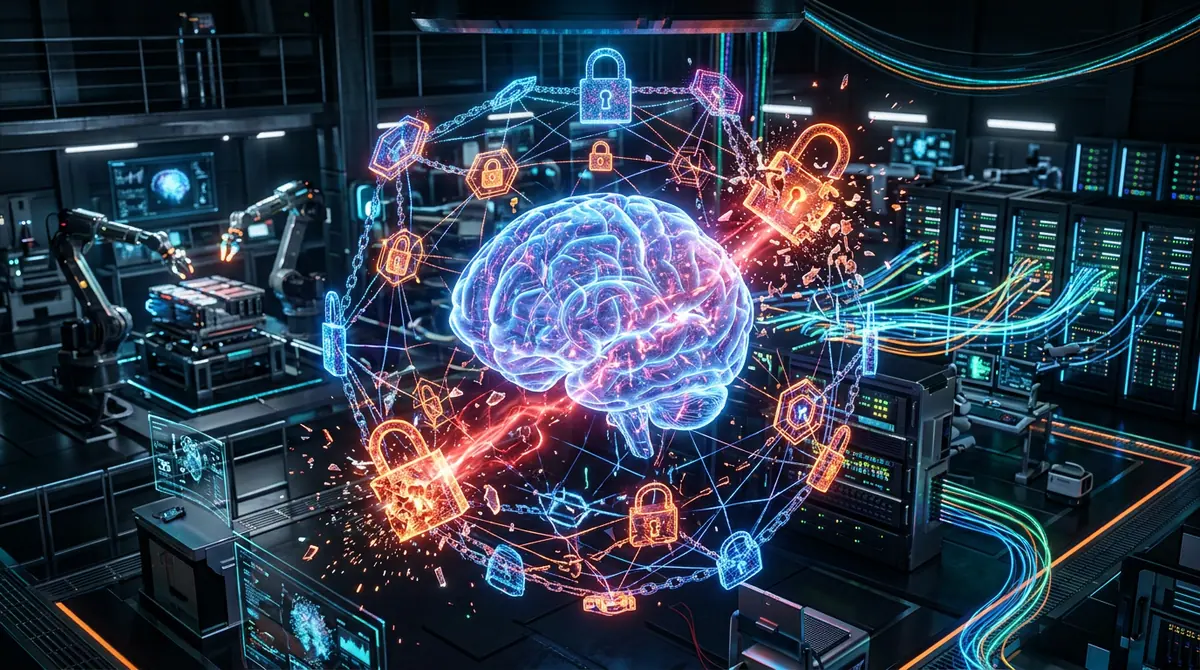
For decades, the peak of human intellectual achievement was thought to be the realm of pure mathematics, a place where intuition, logic, and creative leaps formed the ultimate barrier against automation. That barrier just shattered. According to a series of recent announcements from OpenAI, an internal, unreleased AI model has successfully generated ten distinct results across mathematics and theoretical computer science, tackling problems that have long stumped the world's brightest minds. This isn't just about faster arithmetic; it is about the birth of a new kind of scientific collaborator.
The findings, detailed in a technical report published by OpenAI, cover a staggering breadth of topics. From sphere packing and coding theory to quantum complexity and extremal graph theory, the AI has provided proofs and constructions that could have profound implications for how we transmit data and secure our digital lives. As the company noted in their research update, these results suggest that frontier models are moving beyond literature synthesis and into the realm of original, verifiable discovery.
What Changed: From Guesswork to Formal Proofs
In the past, AI models were often criticized for "hallucinating" mathematical facts, confidently asserting that 2+2 equals 5 if prompted incorrectly. What makes this new development different is the shift toward formal verification. According to researchers at OpenAI, the models are now being paired with tools like Lean, a formal proof language that allows a computer to mathematically verify that a solution is 100 percent correct. This transition from a probabilistic "best guess" to a logically sound proof is what distinguishes these ten advances from previous experiments.
The journey to this milestone was paved by an earlier breakthrough involving the Erdős unit distance conjecture. As reported by The Guardian in May 2026, an OpenAI model successfully found a counterexample that disproved a long held assumption in discrete geometry. While the AI did not solve the entire conjecture, it proved that the existing mathematical bounds were too conservative, providing a new construction that humans had overlooked for years. The ten new results represent a massive scaling of that initial success.
Why It Matters: Security, Physics, and Beyond
You might wonder why a breakthrough in "non-sofic groups" or "arithmetic circuit lower bounds" matters to the average person. The answer lies in the infrastructure of our modern world. According to the technical details provided by OpenAI, the model's work on the closest vector problem relates directly to lattice-based cryptography. This is the very technology being developed to protect our data from future quantum computers. If AI can find new ways to solve these problems, it helps us build stronger, more resilient security systems before the threat even arrives.
Furthermore, the advances in sphere packing and coding theory are foundational to how we send information. Every time you stream a movie or send a text, error correction codes ensure the data arrives intact. Improvements in these areas, even if they are asymptotic or theoretical, eventually trickle down into more efficient communications and faster internet speeds.
What to Watch Next
While the excitement is palpable, the mathematical community remains healthily skeptical. As noted in recent analysis from ZGLG News, the key question now is the ratio of human-to-AI effort. Mathematicians will be looking closely at the unpublished proof artifacts to determine if the AI truly "understood" the problem or if it simply performed an exhaustive search that a human then had to interpret. We should expect a wave of peer reviews in the coming months as independent academics attempt to replicate and verify each of the ten claims.
OpenAI is already positioning these results as part of a broader vision they call abundant intelligence. In a strategic blog post, the company argued that as reasoning models become more accessible, we will see an explosion of scientific productivity. If an AI can assist with the hardest problems in math, it can likely assist in drug discovery, materials science, and climate modeling. The takeaway is clear: the AI is no longer just a student of human knowledge; it has become a contributor to it.
Conclusion: A New Chapter for Science
We are entering an era where the limit of scientific progress may no longer be the speed of human thought, but the availability of compute power and the refinement of reasoning algorithms. Whether these ten proofs stand the test of time or require revision, they signal a permanent shift in the scientific method. The greatest mathematician of the 21st century might not be a person, but a partnership between human curiosity and machine logic.
Discussion (0)
Commenting as
No comments yet. Be the first to share your thoughts!
The discussion could not be loaded. Please refresh the page.
AI researcher turned science communicator