
OpenAI’s $20 Billion Gamble: Building the Future of AI in the Georgia Clay
OpenAI is evolving from a software company into an infrastructure giant. Explore how Project Camellia and new ambient AI tools are changing everything we know about technology.
Key takeaways
- OpenAI is shifting from a software-focused model to a heavy infrastructure provider with the $20 billion Project Camellia.
- The new Georgia data center will utilize a closed-loop water system and a 3.2 GW power arrangement to mitigate environmental concerns.
- OpenAI Presence suggests a new product category focused on ambient, persistent AI interactions beyond the traditional chat interface.
- Enterprise applications are showing massive productivity gains, such as NTT DATA reducing incident analysis time to 30 minutes using Codex.
The Era of Physical AI Infrastructure Begins
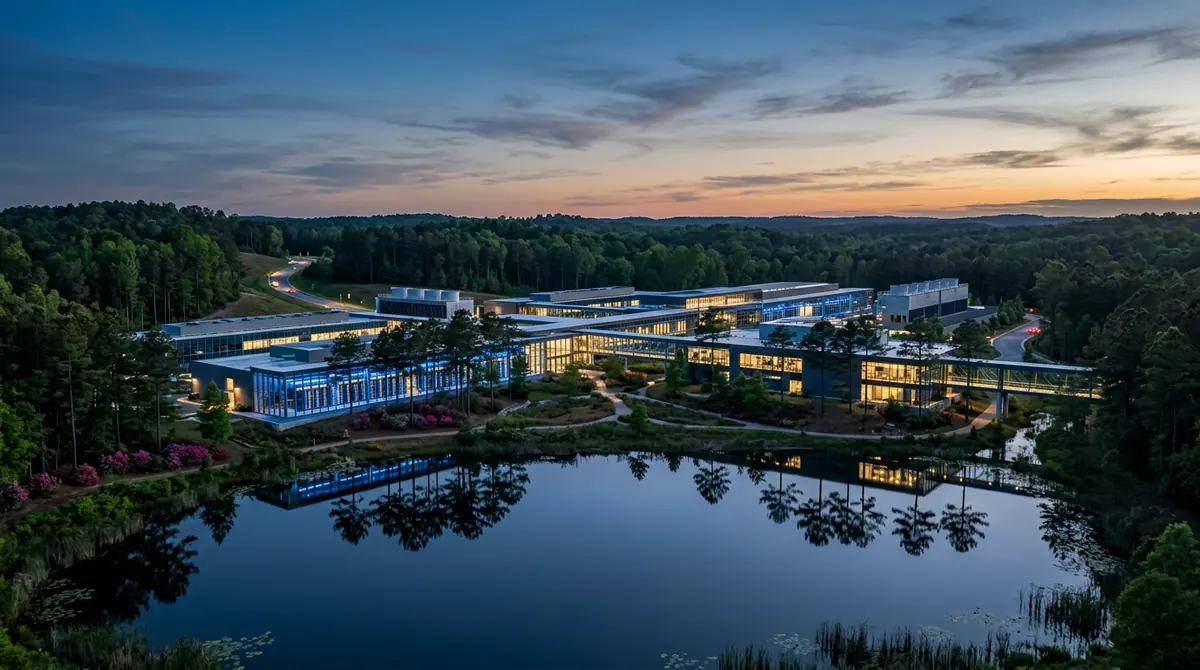
OpenAI is no longer content to live inside someone else’s cloud. In a move that signals a massive strategic pivot, the company is breaking ground on its own massive physical footprint. Known internally as Project Camellia, the effort involves a staggering $20 billion initial investment to build a state-of-the-art data center campus in Effingham County, Georgia. This is not just another office building; it is a play for total independence in the race for artificial general intelligence. According to reporting by The Current GA, the project is slated to draw up to 3.2 gigawatts of power through an arrangement with Georgia Power, with a phased delivery schedule stretching between 2028 and 2032.
For years, the tech world has viewed AI as a software challenge, but the bottleneck has shifted. The future of intelligence now depends on two things: electricity and water. By moving into Effingham County, OpenAI is attempting to solve the hardware constraint by designing its own infrastructure from the ground up. This shift from renting cloud capacity to building physical campuses suggests that the company wants absolute control over its costs, timing, and scale. As reported by Business Insider, the project is specifically designed to address public concerns about sustainability, utilizing a closed-loop water system to ensure that water consumption remains minimal, even as the servers run at full tilt.
What Has Changed: From Chatbots to Institutions
The Georgia project is only one piece of a much larger puzzle. For the first time, we are seeing OpenAI transition from a research lab that releases models to an institutional powerhouse that builds infrastructure, manages distribution, and forms deep partnerships. This is a fundamental shift in how the company operates. In the past, we waited for the next version of GPT; now, we are watching the company embed itself into the very fabric of society.
One of the most intriguing developments in this expansion is the mention of OpenAI Presence. While details remain sparse, the name suggests a move toward ambient, multimodal AI that is always available rather than tucked away in a chat window. This points to a future where AI is integrated into our physical and digital environments, acting as a proactive assistant that understands context in real time. This aligns with the company's recent focus on making AI more agentic, meaning it can perform tasks on your behalf rather than just answering questions.
Why It Matters for the Industry
This move into infrastructure and institutional partnerships matters because it sets a new bar for what it means to be an AI company. It is no longer enough to have the best algorithm; you must also have the best power purchase agreement and the most robust community trust. OpenAI is actively courting local stakeholders in Georgia, promising $80 million in community benefits and education credits for students. As noted in a blog post by OpenAI, they are positioning themselves as a partner in national science and local economic development.
The impact is already being felt in the enterprise sector. For example, the NTT DATA Group recently reported that using OpenAI’s Codex has slashed the time needed for incident analysis from hours to just 30 minutes. This demonstrates that the value of AI is moving beyond abstract promises and into measurable, high-value workflows. When an engineering team can diagnose a system failure in a fraction of the time, the economic ripple effects are massive.
What to Watch Next
As Project Camellia moves forward, the primary challenge will be navigating the social and environmental friction that comes with large-scale industrial projects. While OpenAI has promised minimal water use, the sheer scale of a 3.2-gigawatt power demand will test the limits of the local grid. Observers should watch for how other tech giants respond. If OpenAI successfully builds its own infrastructure, it may force competitors like Google and Meta to rethink their own dependency on traditional cloud providers.
Furthermore, the push into national science suggests that we will see more AI-driven breakthroughs in fields like biology and materials science. If OpenAI can prove that its models are not just for writing emails but for accelerating the next great scientific discovery, the company will secure its place as an essential piece of national infrastructure. The next few years will determine if this $20 billion bet on the Georgia clay will be the foundation of a new era of human progress or a cautionary tale of overextension.
A Final Thought
We are witnessing the industrialization of intelligence. Just as the steam engine required coal and the internet required fiber optics, the next era of AI requires a physical foundation that can support its growing appetite for power. By building Project Camellia, OpenAI is making a bold claim: the future of AI is not just in the code, it is in the ground beneath our feet.
Sources (7)
Discussion (0)
Commenting as
No comments yet. Be the first to share your thoughts!
The discussion could not be loaded. Please refresh the page.
Robotics and automation industry analyst