
Ocean Engineers: Why Orcas are Ramming Sunfish Until They Explode
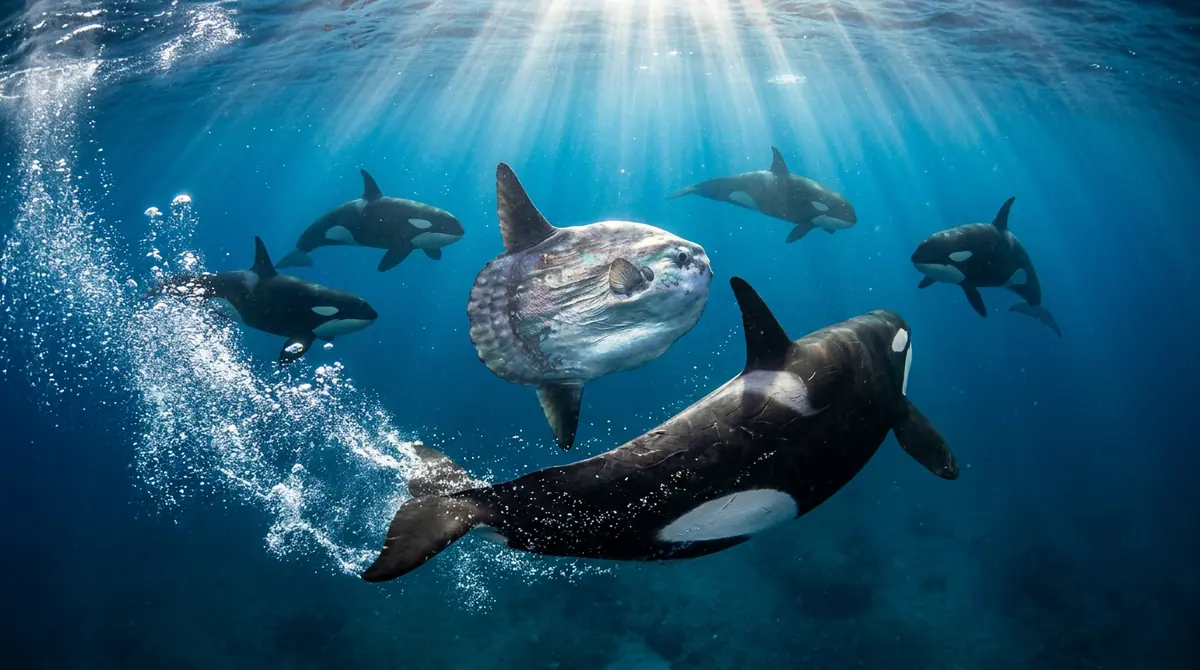
New research reveals orcas in the Gulf of California are using high-impact ramming to 'process' giant sunfish, showcasing a terrifyingly brilliant form of social learning and culture.
Key takeaways
- Orcas in the Gulf of California are using coordinated ramming to break apart giant sunfish for easier consumption.
- The behavior is categorized as 'food processing' and social learning rather than just a predatory kill, as the prey was already dead.
- Juveniles are present during these events, suggesting the behavior serves as a form of training or social bonding.
- This discovery reinforces the idea that orcas possess distinct local cultures and the ability to innovate new ways to solve environmental challenges.
The Shattering Secrets of the Gulf of California
Imagine a massive sunfish, a disk shaped creature that can weigh as much as a small car, floating peacefully beneath the waves. Suddenly, a team of apex predators emerges from the depths, not to bite, but to strike. In a display of coordinated power, orcas are now being documented using high impact ramming techniques to literally shatter their prey into bite sized pieces. This behavior, described as food processing, represents a stunning intersection of biological innovation and social culture among the ocean's most intelligent inhabitants.
According to a peer reviewed report recently published in Frontiers in Ethology, researchers have documented two specific events in the Gulf of California where orcas worked together to smash dead sunfish into fragments. While orcas are well known for their diverse hunting strategies, the sheer force and coordination required to turn a rubbery, heavy carcass into accessible snacks suggests that these whales are doing more than just eating. They are engineering their environment to make survival easier for the entire pod, especially for the younger members who may lack the jaw strength to tackle such massive prey.
Context Box: The Ocean's Cultural Geniuses
Orcas are not a monolith; they are a collection of distinct cultures. Different pods across the globe develop unique traditions, from the wave washing techniques used to knock seals off ice floes in the Antarctic to the recent, mysterious boat ramming incidents near the Iberian Peninsula. These behaviors are not programmed by genetics. Instead, they are learned socially, passed down from elders to juveniles through observation and practice. This makes the orca one of the few species on Earth, alongside humans and certain primates, to exhibit true cumulative culture.
What Has Changed: From Killing to Processing
The latest reporting from Smithsonian Magazine highlights a critical distinction in these new observations: the sunfish were already dead before the ramming began. This shift in perspective suggests that the high impact behavior is not a new kill technique, but rather a sophisticated form of food processing or even an educational tool. In previous years, scientists viewed orca attacks as purely predatory. However, as noted in reports by CNN, the presence of juveniles during these ramming events indicates that the pod might be using these carcasses for training or social bonding.
By smashing the tough, leathery skin of the sunfish, the adult orcas provide the younger whales with easier access to nutritious internal organs. This is the marine equivalent of a parent cutting up food for a child, albeit on a much more visceral and explosive scale. Researchers writing for Scientific American suggest that this could also be a form of play, a way for highly cognitive animals to burn energy and refine their physical coordination in a low risk environment.
Why It Matters: The Evolution of Non-Human Innovation
This discovery matters because it forces us to rethink our definition of innovation. We often think of technology as something involving silicon and steel, but for an orca, innovation is a new way to use their body and their social structure to solve a problem. The ability to identify a dead sunfish as a resource and then use a coordinated physical maneuver to process it shows a high level of situational awareness and problem solving. As ABC News reported, these interactions show that orcas can develop local traditions around contact with large objects, a trend that seems to be accelerating globally.
Furthermore, these findings emphasize the importance of social structures in nature. If these behaviors were merely instinctive, we would see them everywhere sunfish and orcas coexist. Instead, we see them in specific regions, suggesting that this is a localized invention (a piece of intellectual property shared only within a specific orca community). It highlights the fragility of these cultures; if a pod is lost, its unique innovations and ways of living die with it.
What to Watch Next
As we move further into 2026, marine biologists are keeping a close eye on whether this behavior spreads to other pods. Much like a viral video on social media, successful orca behaviors can move through populations through horizontal transmission. We should watch for similar reports in other regions where sunfish are common, such as the Mediterranean or the coast of Australia. Additionally, researchers are now looking to see if this ramming behavior translates to other types of large prey or even human made objects, potentially offering more clues into the recent spike in whale interactions with boats. The ocean is not just a habitat (it is a classroom and a laboratory) and the orcas are currently its most ambitious students.
Sources (5)
Discussion (0)
Commenting as
No comments yet. Be the first to share your thoughts!
The discussion could not be loaded. Please refresh the page.
Mobile app developer and UX design writer