
Musk v. Altman: The High-Stakes Legal Battle for the Soul of AI Begins
Jury selection has officially begun in the landmark case between Elon Musk and OpenAI. At stake? The future of artificial intelligence and hundreds of billions of dollars.
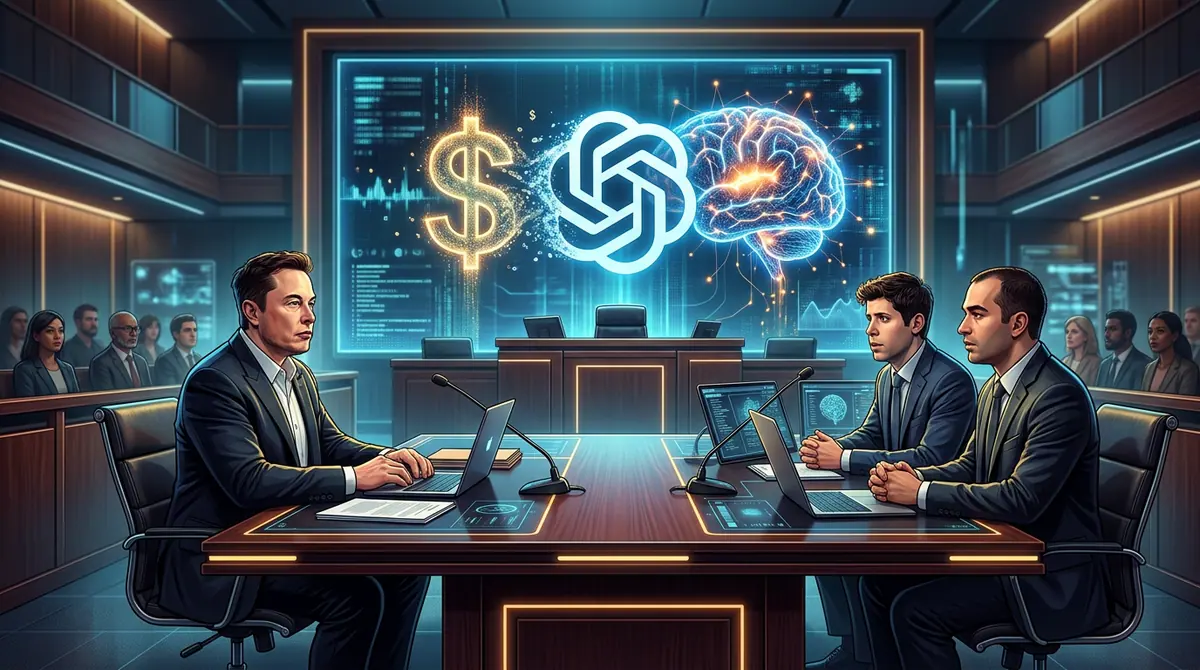
Key takeaways
- Jury selection began on April 27, 2026, for the multi-billion-dollar lawsuit between Elon Musk and OpenAI leadership.
- The central claim is a breach of contract regarding OpenAI's transition from a nonprofit to a for-profit entity now valued at $852 billion.
- The jury will serve in an advisory role to Judge Yvonne Gonzalez Rogers in the U.S. District Court for the Northern District of California.
- The trial will test the legal weight of nonprofit founding principles in the face of massive commercial success and external investment from partners like Microsoft.
The Courtroom Drama in Oakland
The future of the world's most powerful technology is currently being debated in a federal courtroom in Oakland, California, where the personal and professional rift between two of Silicon Valley's most famous figures has finally come to a head. On Monday, April 27, 2026, jury selection began for the multi-billion-dollar showdown between Elon Musk and OpenAI leaders Sam Altman and Greg Brockman. This case represents more than just a dispute between former colleagues; it is a fundamental trial over the ethics, governance, and commercialization of artificial intelligence.
The courtroom scene, as described in reports by CNBC and NBC, was charged with tension as attorneys began the arduous process of narrowing down a pool of approximately 100 potential jurors. According to Bloomberg Government, this trial serves as a critical test for how the American legal system handles high-profile technology disputes involving figures of extreme celebrity. Musk, whose polarizing public persona was compared by a previous judge to the status of a president, poses a unique challenge for jury selection. Attorneys are currently using extensive written questionnaires and voir dire to filter out deep-seated biases from residents across seven Bay Area counties.
The Core Conflict: A Mission Abandoned?
At the heart of the lawsuit, which was refiled in the U.S. District Court for the Northern District of California (Case No. 4:24-cv-04722), is Musk's allegation that Altman and Brockman betrayed the founding principles of OpenAI. When the organization was established in 2015, it was positioned as a nonprofit dedicated to developing artificial general intelligence (AGI) for the benefit of humanity, rather than for shareholder profit. Musk claims that the company shifted its focus toward commercial gain after the massive success of ChatGPT in late 2022, effectively transforming into a for-profit entity that is now valued at an estimated $852 billion.
While Judge Yvonne Gonzalez Rogers previously dismissed fraud claims related to the case, the breach of contract allegations remain the central pillar of the trial. Musk is seeking to have Altman removed from the board and wants unspecified funds directed back to OpenAI's charitable arm. According to background details shared by AnnieLytics, this legal battle has been years in the making, following Musk’s departure from the OpenAI board in 2018 and a failed attempt at a settlement in 2025.
The Context Box: How We Got Here
OpenAI was founded in 2015 by Elon Musk, Sam Altman, and several others as a nonprofit alternative to Big Tech's closed AI research. Musk provided significant early funding, but he left the organization in 2018 over disagreements regarding the company’s direction and its relationship with Microsoft. Since then, OpenAI has transitioned to a capped-profit model, accepting billions in investment from Microsoft (a co-defendant in the case) while leading the global AI revolution. This trial is the ultimate reckoning of whether those founding non-profit promises were legally binding contracts or merely aspirational goals.
Why This Trial Matters to You
The outcome of this case could redefine how all major AI startups are structured in the future. If Musk succeeds, it may force a massive restructuring of OpenAI and could potentially slow the pace of commercial AI releases in favor of more transparent, nonprofit-style research. For the average user, this could mean changes in how tools like ChatGPT are updated, priced, or shared with the public. Furthermore, the trial highlights the enormous influence that a few individuals hold over the most transformative technology of the 21st century. It raises the question: Should the development of AGI be controlled by a for-profit board or by an entity focused solely on public benefit?
What Changed and What is New
The start of jury selection marks a significant shift from theory to reality. For two years, this battle existed mostly in the form of social media posts and legal filings. Now, real citizens will decide the fate of an organization valued at nearly a trillion dollars. The most recent development is the judge's decision to move forward with the breach of contract claims while narrowing the scope of the trial, ensuring that the jury stays focused on the specific agreements made during OpenAI’s early days rather than getting lost in the broader philosophical debates surrounding AI safety.
What to Watch Next
As the trial proceeds, watch for the specific role of the jury, which CNBC reports will serve in an advisory capacity to Judge Gonzalez Rogers. The defense will likely focus heavily on neutralizing any negative public perceptions of Musk while emphasizing the technical and financial necessity of OpenAI's current corporate structure. Keep a close eye on testimony regarding Microsoft's involvement, as their partnership with OpenAI is a central component of Musk's claim that the nonprofit mission was compromised for corporate profit. Regardless of the verdict, this case will likely set a legal precedent for the entire Silicon Valley ecosystem for decades to come.
The Bottom Line
The legal clash between Elon Musk and Sam Altman is the ultimate battle over the soul of innovation. Is artificial intelligence a public good that should be guarded by nonprofit ideals, or is the for-profit model the only way to fund the staggering costs of AGI? As the jurors in Oakland take their seats, the world waits to see if the original vision of OpenAI was a binding promise or just a stepping stone to the largest commercial success in history.
Discussion (0)
Commenting as
No comments yet. Be the first to share your thoughts!
The discussion could not be loaded. Please refresh the page.
EdTech specialist and former computer science educator


