
Jeff Bezos’s Giant Leap: Blue Origin Finally Masters the Reusable Rocket
Blue Origin just reached its most critical milestone yet, reusing the New Glenn booster for the first time. But a payload mystery suggests the race for space dominance is far from over.
Key takeaways
- Blue Origin successfully achieved its first reuse of the New Glenn booster on April 19, 2026.
- The mission faced a setback when the upper stage failed to deploy the AST SpaceMobile BlueBird 7 satellite into its intended orbit.
- Despite the booster reuse, all seven BE-4 engines were replaced for this flight as part of a cautious refurbishment strategy.
- The booster is designed for a minimum of 25 flights to dramatically reduce the cost of orbital launches.
- Success in this program is critical for AST SpaceMobile's goal of launching 45-60 satellites by the end of 2026.
The Era of the Reusable Heavy-Lifter is Here
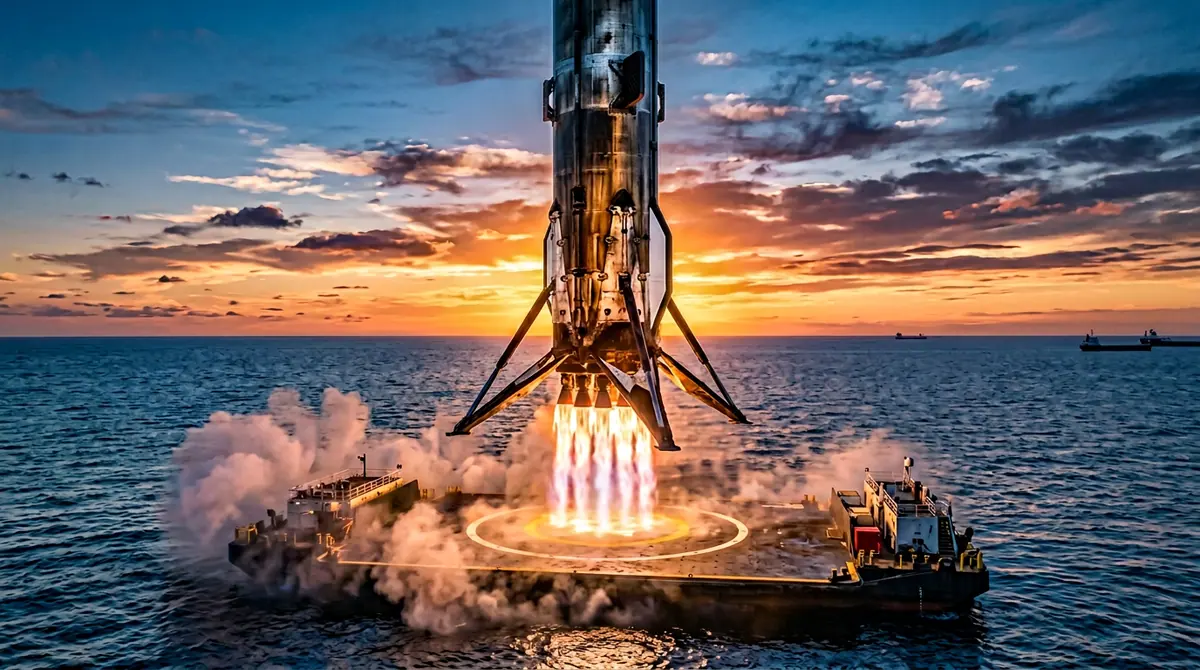
Jeff Bezos just proved that lightning can strike twice, and it looks a lot like a seven-engine rocket booster landing on a ship in the middle of the ocean. On April 19, 2026, Blue Origin achieved a feat that has long been the holy grail for the company: the first-ever reuse of its massive New Glenn booster. The rocket, cheekily nicknamed Never Tell Me the Odds, soared into the Florida sky for its third flight, marking a turning point in the competitive landscape of the private space sector. According to a report by TechCrunch, the booster successfully returned to Earth and was recovered approximately 10 minutes after takeoff, landing gracefully on the drone ship Jacklyn.
This is not just another launch; it is the moment Blue Origin officially entered the ring as a heavyweight contender against SpaceX. For years, the industry has watched as Elon Musk’s Falcon 9 dominated the market through rapid refurbishment and reuse. Now, the New Glenn has shown it can do the same, even if the road to this milestone was paved with technical hurdles and intense scrutiny. However, as with any high-stakes innovation, the victory was tempered by a significant mystery involving the mission’s final objective.
The Refurbishment Reality Check
While the successful landing of the booster is a triumph, the process behind it reveals the complexities of modern rocket science. In a disclosure shared by Blue Origin CEO Dave Limp, it was revealed that all seven BE-4 engines on the Never Tell Me the Odds booster were actually replaced prior to this flight. This distinguishes the current approach from the seamless, gas-and-go reuse often associated with commercial aircraft. According to Spaceflight Now, the company used this mission to test critical upgrades, including a new thermal protection system on one of the engine nozzles. Limp indicated that while the engines from this specific flight will be retained for future missions, the company is still in a phase of iterative learning, perfecting the hardware before moving to a continuous cycling model.
The Payoff and the Problem
The primary customer for this historic flight was AST SpaceMobile, a company with the ambitious goal of providing space-based cellular broadband directly to everyday smartphones. The payload consisted of the BlueBird 7 satellite, a massive Block 2 communications array with antenna and solar panels spanning 2,400 square feet. This is where the story takes a complicated turn. While the booster performed its job perfectly, the upper stage of the rocket encountered what appears to be a malfunction. Reports from industry observers indicate that the BlueBird 7 ended up in an off-nominal orbit, suggesting the upper stage failed to execute its second burn correctly about an hour after liftoff. This serves as a stark reminder that in aerospace, even when you solve the hardest problem (the landing), the fundamentals of orbital mechanics remain unforgiving.
Context Box: Why New Glenn Matters
For newcomers to the space race, the New Glenn is Blue Origin's heavy-lift orbital launch vehicle, named after the first American to orbit the Earth, John Glenn. Unlike the smaller New Shepard rocket, which only touches the edge of space for tourism, New Glenn is a behemoth designed to carry massive payloads into Earth’s orbit and beyond. Its first stage is engineered for at least 25 flights, a design choice intended to slash the cost of access to space. By mastering reuse, Blue Origin hopes to move from being a research-heavy venture into a high-frequency commercial launch provider that can compete directly for government and private satellite contracts.
What Changed: The Delta from Before
The significance of this flight lies in the transition from theory to practice. Before April 19, 2026, the New Glenn’s reuse capabilities were largely confined to press releases and technical blueprints. Now, Blue Origin has a flight-proven booster that has successfully returned from an orbital trajectory not once, but twice. This shifts the company's status from an aspirant to a proven player in the reusable market. Furthermore, the decision to replace all seven engines shows a pivot toward a more conservative, safety-first refurbishment strategy as they scale up, compared to the aggressive engine reuse seen in other programs.
Why It Matters
The economics of space are entirely dependent on how many times you can use a single piece of hardware. When a rocket is discarded after one flight, the cost of the mission must cover the entire manufacturing price of the vehicle. By reusing a booster 25 times, the cost of the hardware is amortized, theoretically dropping the price of a launch by millions of dollars. For consumers, this means cheaper satellite internet, better global connectivity, and more frequent scientific missions. For AST SpaceMobile specifically, the success of New Glenn is vital. The company aims to deploy 45 to 60 satellites by the end of 2026, a cadence that requires a reused booster every 30 days. Without Blue Origin's success, the dream of global 5G from space would likely remain grounded.
What to Watch Next
Keep a close eye on the investigations into the upper-stage failure. Blue Origin must identify whether the satellite deployment issue was a one-off software glitch or a systemic hardware flaw in the second stage. Additionally, the industry will be watching to see how quickly Never Tell Me the Odds can be turned around for its fourth flight. The ultimate test will be whether Blue Origin can eventually stop replacing all seven engines between flights and move toward the airliner-like operations Dave Limp has promised. If they can nail that transition, the 2020s will be remembered as the decade when space truly became a sustainable commercial frontier.
Discussion (0)
Commenting as
No comments yet. Be the first to share your thoughts!
The discussion could not be loaded. Please refresh the page.
EdTech specialist and former computer science educator


