
IBM Unveils Analog AI Chip: The Hardware Revolution Saving Our Power Grid
IBM's latest analog chip breakthrough promises to slash AI energy consumption while maintaining the power of massive neural networks.
Key takeaways
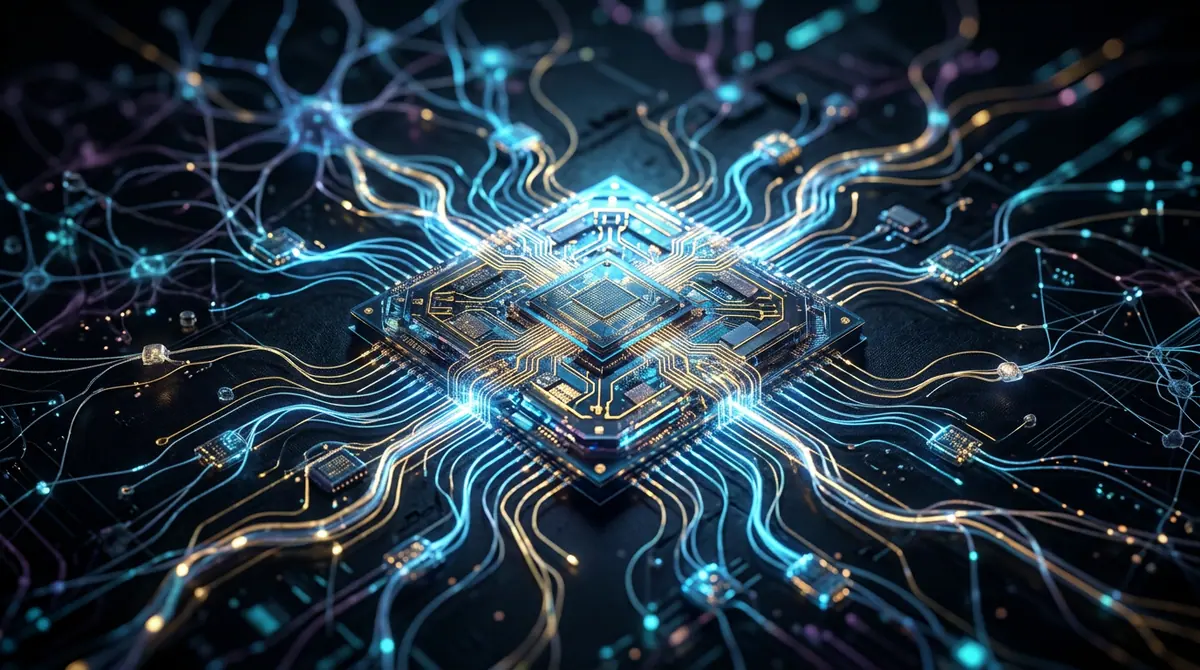
- IBM's new analog chip mimics biological neurons to perform AI tasks with massive energy savings compared to digital chips.
- Google's TurboQuant algorithm uses advanced memory compression to enable AI to handle much larger contexts and longer conversations.
- A recent study showed that GPT-3's philosophical reasoning is now on par with human experts, raising new questions about machine consciousness.
- The industry is shifting from a 'bigger is better' approach to focusing on architectural efficiency and localized AI capabilities.
The Energy Crisis of the Artificial Mind
The global hunger for artificial intelligence is currently colliding with the physical limits of our power grid. Every time a user interacts with a large language model, a silent surge of electricity pulses through a data center, generating heat and consuming resources at an unsustainable rate. However, a major breakthrough might have just changed the trajectory of the industry. According to a report by IBM Research on April 14, 2026, the company has successfully demonstrated a breakthrough analog AI chip that could solve the most pressing problem in computing: energy efficiency.
This development represents a fundamental shift in how we think about the physical brain of a computer. For decades, the tech world has relied on digital chips that process information using binary logic (the familiar zeros and ones). While digital systems are precise, they are notoriously inefficient at moving the massive amounts of data required for modern deep learning. IBM's latest innovation sidesteps this bottleneck by using analog components that can store and process data in the same location, mimicking the way biological neurons operate in the human brain. The company announced that this chip offers high accuracy for neural network computations while using significantly less energy than its digital counterparts.
Context Box: What is Analog Computing?
Unlike traditional digital computers that rely on discrete on-or-off switches, analog computing uses continuous physical signals, such as varying levels of electrical voltage or resistance, to represent data. In the context of AI, this allows the chip to perform complex mathematical operations, specifically the matrix multiplications that power neural networks, directly within memory. By eliminating the need to constantly shuffle data between a processor and a separate memory bank, analog chips can operate with a level of efficiency that digital hardware simply cannot match.
The Software Side: Google's Quest for Massive Context
While IBM is tackling the hardware problem, other giants are focusing on the mathematical efficiency of AI models. Research published by Google on April 2, 2026, introduced a new algorithm called TurboQuant. This technology is designed to address the memory overhead of large AI models, particularly the Key-Value (KV) cache that grows as models process longer strings of text. According to the Google research team, TurboQuant utilizes memory compression methods known as PolarQuant and Quantized Johnson-Lindenstrauss to shrink the footprint of these models without sacrificing performance. This means that AI systems of the future will be able to remember and process much larger amounts of information, such as entire libraries of books or hours of video, without requiring a supercomputer to stay running.
When AI Becomes a Philosopher
As the hardware and software become more efficient, the outputs are becoming increasingly indistinguishable from human thought. A fascinating study published on April 15, 2026, examined the philosophical capabilities of OpenAI's GPT-3. The research found that the AI's responses were virtually indistinguishable from those of human philosophers. This discovery, highlighted in recent industry reports, suggests that our models are not just predicting the next word in a sentence; they are beginning to capture the nuance, logic, and abstract reasoning that we once thought were unique to the human experience.
What Changed: The Shift from Digital to Hybrid
For the last ten years, the mantra of the AI industry has been "bigger is better." We built larger models and threw more digital GPUs at the problem. What has changed this month is the realization that the digital-only path is reaching a point of diminishing returns. The introduction of IBM's analog chip proves that we are moving toward a hybrid future. In this new era, digital systems will likely handle the precise logic and storage, while specialized analog cores will take over the heavy lifting of neural network processing. This delta marks the transition from the brute-force era of AI to the era of architectural elegance.
Why It Matters for You
You might wonder why a chip design or a compression algorithm matters to the average consumer. The implications are actually quite personal. Today, the most powerful AI models must live in the cloud because they are too large and power-hungry for a smartphone. The breakthroughs from IBM and Google mean that high-level AI could soon reside locally on your devices. This would mean faster response times, better privacy since your data never leaves the phone, and significantly longer battery life. Furthermore, as companies like Commvault recently introduced features like the "Ctrl-Z" undo function for AI workloads, the tools we use are becoming more resilient and easier to manage in real-world professional environments.
What to Watch Next
Keep a close eye on the miniaturization of these analog technologies. Over the next eighteen months, we expect to see the first wave of consumer devices integrated with analog AI accelerators. We should also look for more research into how these philosophical AI models are integrated into education and ethics committees. If an AI can think like a philosopher, will it soon be helping us draft our laws or mediate our most complex social disputes? The boundary between human reasoning and machine processing is blurring faster than anyone predicted.
The era of energy-expensive, cloud-dependent AI is ending. In its place, a more efficient, thoughtful, and local form of intelligence is rising. Whether through the physical ingenuity of IBM's analog circuits or the mathematical brilliance of Google's algorithms, the future of AI is becoming more human in more ways than one.
Sources (6)
Discussion (0)
Commenting as
No comments yet. Be the first to share your thoughts!
The discussion could not be loaded. Please refresh the page.
Mobile app developer and UX design writer


