
GPT-5.4 and Genie 3: The Week AI Finally Stepped into the Real World
From OpenAI's GPT-5.4 launch to DeepMind's interactive 3D worlds, the AI landscape just shifted. Here is how these massive breakthroughs are redefining your work and reality in 2026.
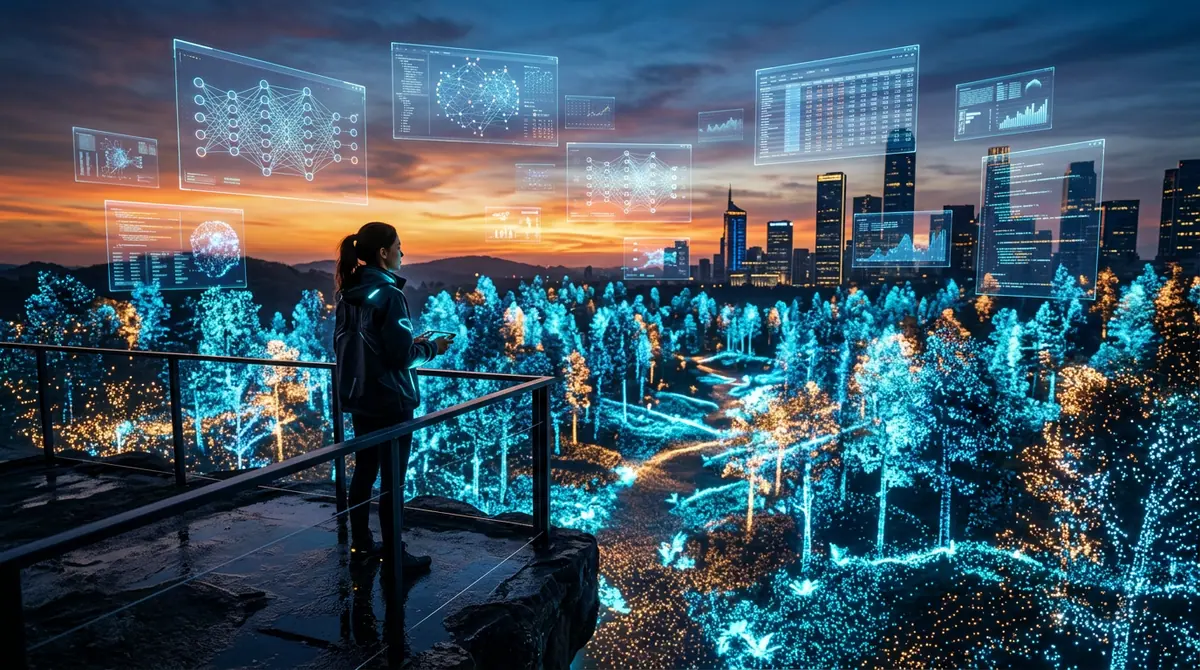
Key takeaways
- GPT-5.4 marks a shift toward specialized professional tasks with deep integration into tools like Excel and enhanced security features.
- Google DeepMind's Genie 3 introduces the ability to generate interactive, physics-compliant 3D environments from text prompts.
- Anthropic's Claude Opus 4 can now operate autonomously for up to seven hours, signaling the rise of the 'AI agent' over the 'AI chatbot'.
- Geopolitical and corporate boundaries are hardening, as seen with JPMorgan blocking AI access in Hong Kong and Europe building its own frontier model infrastructure.
- Small models, such as Alibaba's Qwen 3.5, are proving that efficiency and smart architecture can outperform sheer parameter size.
The Great Acceleration of June 2026
Imagine waking up to a world where your spreadsheet doesn't just calculate numbers, it reasons through them, and where your text prompts can instantly generate a 3D environment you can walk through in real time. We are no longer living in the era of simple chatbots. According to recent industry reports, the past week has delivered a flurry of announcements from the world's leading AI labs that signal a fundamental shift in what machine intelligence can do. From the professional capabilities of OpenAI's newest frontier model to the creative sandbox of Google DeepMind, the boundaries between digital assistance and autonomous capability are vanishing.
OpenAI's Power Move: GPT-5.4 and Codex Security
The headline of the week is undoubtedly OpenAI's release of GPT-5.4. As reported by insights shared on LinkedIn, this model is being positioned as a specialized frontier system designed for complex professional tasks that would have stumped earlier versions. But it is the specific integrations that have caught the industry's eye. OpenAI has reportedly added Codex Security to its suite, alongside a direct ChatGPT for Excel integration. This isn't just about chatting; it is about providing enterprise-grade security for code while allowing users to execute complex data reasoning directly within their most used software tools.
The Technical Edge: Why GPT-5.4 Matters
While previous models were criticized for hallucinations in professional settings, GPT-5.4 aims to solve the reliability gap. By integrating deeper reasoning layers, the model can handle multi-step workflows with a level of precision that makes it a viable partner for engineers and financial analysts. This release comes at a critical time as OpenAI moves toward a potential IPO, a transition highlighted in recent coverage by TechCrunch as the company aggressively hires top-tier talent to scale its operations.
Google DeepMind's Genie 3: The Birth of the 'Holodeck'
If OpenAI is winning the office, Google DeepMind is conquering reality itself. Research presented by Google DeepMind and featured in recent video roundups has unveiled Genie 3, a model that generates interactive 3D environments from simple text prompts. Unlike previous video generators, Genie 3 creates worlds that obey the laws of physics and allow for real-time interaction at 720p resolution and 24 frames per second.
This is a staggering technical achievement. It means developers and even non-technical users can describe a world, and the AI will manifest a navigable space with consistent memory. If you move a chair in a Genie-generated room and walk away, the chair stays where you left it. This represents a leap in how AI understands 3D space and causality, moving beyond mere image generation into world-building.
What Changed: The Shift to Interactive Intelligence
Until now, AI has been largely passive or reactive. The introduction of Genie 3 and the update to Anthropic’s Claude Opus 4 change that dynamic entirely. According to reports on recent AI innovations, the new Claude Opus 4 can now run autonomously on long-form tasks for up to seven hours. We are moving from "tools you use" to "agents that work," marking the transition from the generative era to the autonomous era.
Context Box: The Frontier Model Race
For those new to the space, the term "Frontier Model" refers to the most advanced AI systems that push the boundaries of what is possible. In 2026, the race is no longer just about who has the most parameters. It is about speed, efficiency, and real-world utility. While giants like OpenAI and Google battle for the high-end market, others like Alibaba are proving that size isn't everything. Alibaba recently released the Qwen 3.5 small models, ranging from 0.8B to 9B parameters, which reportedly outperform systems many times their size in specific benchmarks.
Why it Matters: The Economic and Geopolitical Impact
The implications of these releases extend far beyond Silicon Valley. A report from Reuters highlights a growing divide in how this technology is governed and accessed. For instance, JPMorgan Chase recently blocked staff in Hong Kong from accessing Anthropic’s models, a move that reflects the tightening scrutiny around cross-border AI use and data sovereignty. Meanwhile, in Europe, OVHcloud is positioning itself as a regional challenger to companies like Mistral by planning to train its own frontier models on European soil.
For the average professional, this means the tools you use are becoming faster and cheaper. Google’s Gemini 3.1 Flash Lite is a prime example, claiming 2.5 times faster responses and 45 percent faster output generation compared to its predecessors. AI is becoming a high-speed utility rather than a slow, expensive luxury.
What to Watch Next
As we look toward the second half of 2026, keep your eyes on the "Great Talent Migration." Reuters reported that Noam Shazeer, a pivotal figure in the development of the transformer architecture, is moving from Google to OpenAI. Such high-profile shifts often precede major architectural breakthroughs. Additionally, keep a close watch on the integration of AI into physical robotics; the spatial reasoning seen in Genie 3 is the exact type of intelligence needed to power the next generation of humanoid workers. The line between the digital world and the physical one is about to get even thinner.
Final Takeaway
We have entered a phase where AI is no longer just an assistant; it is becoming an environment and an autonomous agent. Whether you are navigating a 3D world generated by Genie 3 or letting Claude Opus 4 handle a seven-hour coding sprint, the message is clear: the speed of innovation is accelerating. The question is no longer what the AI can do, but how quickly we can adapt to a world where the impossible becomes the baseline.
Sources (8)
Discussion (0)
Commenting as
No comments yet. Be the first to share your thoughts!
The discussion could not be loaded. Please refresh the page.
EdTech specialist and former computer science educator


