
Forget the Chatbot: Google’s Gemini for Science Is Your New Research Partner
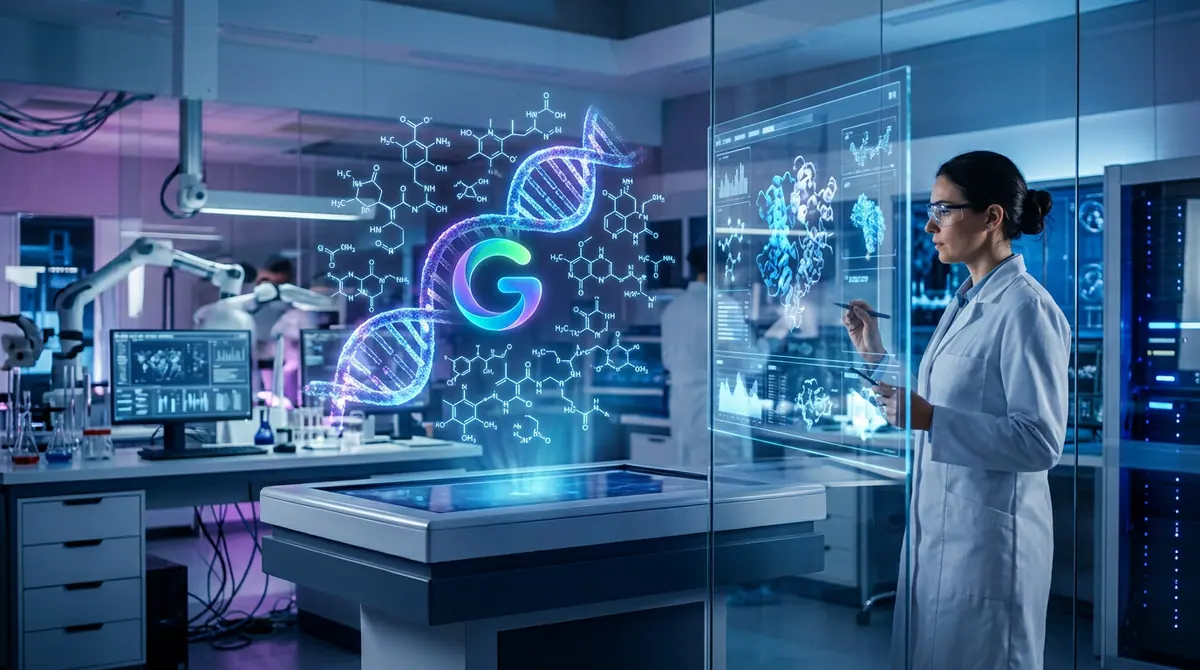
Google just unveiled Gemini for Science at I/O 2026, moving AI beyond simple chat into complex simulations and hypothesis generation. Discover how this shift could redefine the scientific method.
Key takeaways
- Google I/O 2026 introduced 'Gemini for Science,' shifting AI from a chatbot to an integrated research workflow tool.
- The tool focuses on hypothesis generation, literature synthesis, and complex system simulations.
- This move marks a transition from AI as an assistant to AI as a foundational research substrate.
- Despite the potential for accelerated discovery, challenges regarding AI hallucinations and the need for human validation remain paramount.
- The success of the platform depends on Google's ability to unify its tools into a seamless 'super app' for scientists.
The Era of the Digital Lab Assistant Has Arrived
The era of using artificial intelligence merely to summarize papers or fix typos is officially over. At the Google I/O 2026 keynote, the tech giant unveiled its most ambitious scientific project to date: Gemini for Science. This is not just another chatbot interface; it is a foundational shift in how human knowledge is expanded. According to the company announcement, this new suite of tools is designed to turn research goals into functional code, generate testable hypotheses, and run complex simulations that were previously impossible to model with traditional methods.
What Changed: From Assistant to Research Substrate
For the past few years, AI has functioned primarily as a productivity layer, helping scientists write faster or organize their schedules. However, as reported by MIT Technology Review AI, we are witnessing a structural change in the scientific method itself. AI is moving deeper into the workflow, acting as a research partner rather than a simple assistant. In the past, a researcher might ask a model to summarize a study. Now, using the Gemini 3.5 framework, scientists can ask the AI to identify gaps in existing literature, propose a novel experiment to fill those gaps, and then write the Python code required to simulate the results.
Simulating the Impossible
Perhaps the most significant pillar of the announcement is the emphasis on simulations. Google highlighted that simulation is critical for scientific domains (such as materials science or climate modeling) that are far too complex for direct traditional modeling. By leveraging the multimodal capabilities of Gemini, researchers can now create digital twins of complex systems. This allows for thousands of iterations in a virtual environment before a single drop of liquid ever touches a test tube in a physical lab.
The Context: Building on a Legacy of Discovery
To understand why this matters, one must look at Google's track record. Years ago, DeepMind’s AlphaFold revolutionized biology by predicting protein structures, a feat that gave Google the credibility to build this broader platform. While AlphaFold solved a specific problem, Gemini for Science aims to provide the infrastructure for all problems. This evolution moves the technology from a single breakthrough tool into a comprehensive research substrate that integrates literature, data, and action.
The Multi-Step Agent Revolution
One of the most compelling aspects of this new workflow is the move toward agentic systems. Unlike a standard chatbot that responds to a single prompt, these AI agents can perform multi-step tasks. In a typical research loop, an agent might locate a dataset, write an analysis script, iterate on the experiment based on errors, and present a final report. This shift toward action-oriented AI was a major theme of the 2026 keynote, signaling that the future of work is not about asking questions but about defining objectives for AI to execute.
Why It Matters: Compressing the Discovery Cycle
The implications for the industry and the world are profound. By automating the routine aspects of the scientific method, the path from a theoretical idea to a physical experiment is dramatically shortened. This could lead to faster breakthroughs in drug discovery, renewable energy, and carbon capture. However, this transition does not come without risks. Experts speaking in recent industry commentary have pointed out that scientific work is high stakes. Because large language models can still hallucinate or overstate their confidence, the role of human validation and scientific judgment remains more critical than ever.
What to Watch Next
As Google positions itself as the go-to platform for scientific discovery, the competition is heating up. While Google remains strong in multimodal AI and scientific data, critics argue that the company still needs to unify its fragmented product ecosystem to create a true super app for knowledge work. Watch for how competitors like OpenAI and Anthropic respond with their own research-specific models. Additionally, keep an eye on the reproducibility of AI-generated science: the next great challenge will be ensuring that these model-generated hypotheses hold up under the rigorous scrutiny of real-world laboratory testing.
The Final Takeaway
We are entering a period where the boundary between the scientist and the software is beginning to blur. Google’s latest move suggests that the future of discovery will not be found in a vacuum but in the collaborative loop between human intuition and machine simulation. The scientific method is being upgraded for the age of intelligence, and the results could change everything.
Sources (2)
Discussion (0)
Commenting as
No comments yet. Be the first to share your thoughts!
The discussion could not be loaded. Please refresh the page.
Digital transformation writer and startup advisor


