
Claude Science: Anthropic’s New Flagship Aims to Solve the World’s Hardest Problems
Anthropic just unveiled Claude Science, a specialized AI platform that lets researchers control how long the machine "thinks" before solving complex biological puzzles.
Key takeaways
- Anthropic launched Claude Science on June 30, 2026, featuring the new Claude 3.7 hybrid model that allows users to control reasoning time.
- A new 'scratchpad' feature provides transparency by showing the model's step-by-step reasoning process, aiding in scientific debugging.
- Anthropic is now valued at $965 billion and is aggressively competing with Google DeepMind for dominance in the European research sector.
- The launch includes a focus on life sciences, supported by initiatives like Project Glasswing and the Nonprofit Intercept to tackle public health challenges.
The Lab Partner That Never Sleeps
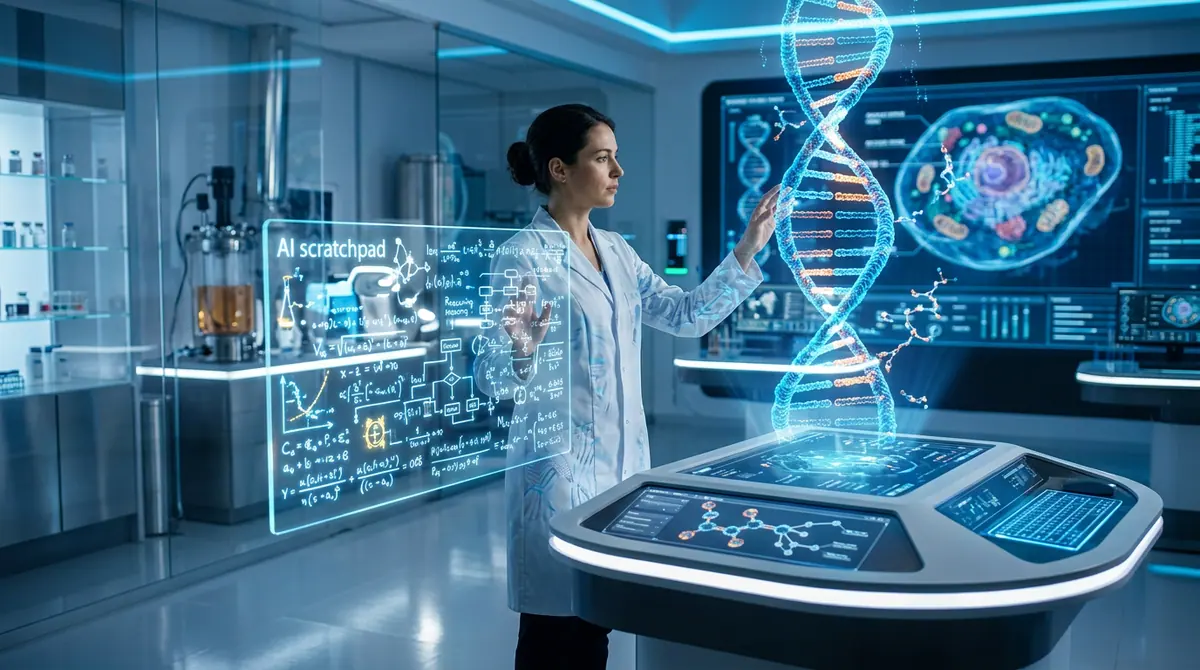
Imagine a research assistant that can parse decades of genomic data in seconds, visualize the folding of a complex protein, and then explain its entire reasoning process step by step on a digital scratchpad. On Tuesday, June 30, 2026, Anthropic turned this vision into a reality with the launch of Claude Science. This new flagship product is not just another chatbot; it is a specialized engine designed to accelerate the pace of human discovery in fields ranging from oncology to materials science.
The Power of Hybrid Reasoning
At the heart of Claude Science lies the Claude 3.7 hybrid AI model. According to technical details shared by Anthropic, this model introduces a revolutionary way for users to interact with machine intelligence: the ability to control the model’s "thinking" time. In a world where speed usually trumps depth, Claude 3.7 allows scientists to trade time or budget for increased reasoning accuracy. If a researcher needs a quick summary of a paper, the model responds instantly. However, for a complex task like identifying potential drug interactions, the user can dial up the reasoning depth, giving the AI more time to ponder the problem before delivering a verified result.
Perhaps the most talked about feature among early adopters is the new scratchpad. Taking a page from the design of the Chinese model DeepSeek, Anthropic has made the AI’s internal monologue visible. As reported by various researchers and hackers on social media platforms, this transparency allows scientists to see how the model reaches its conclusions, making it significantly easier to debug complex scientific problems or refine prompts for better accuracy.
Why it Matters: The Shift to Specialized Discovery
The launch of Claude Science marks a significant pivot for Anthropic, moving it from a general purpose LLM developer to a specialized partner in the life sciences. As noted in a report by MIT Technology Review, this move is crucial because today’s AI is still often unreliable when it comes to understanding physical and biological systems. By focusing specifically on these domains, Anthropic aims to bridge the gap between text generation and genuine scientific utility.
For the industry, this is a clear shot across the bow of Google DeepMind. The Nordic Institute observed on Twitter that Claude Science is strategically positioned to outpace DeepMind in the European AI research landscape. With Anthropic’s valuation reaching a staggering 965 billion dollars in May 2026 (a fact confirmed by recent financial tracking data), the company now has the capital to challenge the established giants of the industry.
Context for Newcomers
Anthropic was founded with a core mission of AI safety and reliability, distinguishing itself from competitors that often prioritize scale at any cost. Unlike OpenAI’s ad-supported ChatGPT, Anthropic has maintained an ad-free policy for its Claude models. The company recently expanded its reach through Project Glasswing, an initiative that brings ethical AI tools to 150 organizations across 15 different countries, ensuring that scientific breakthroughs are accessible globally rather than locked behind corporate silos.
What Changed: A New Era of Transparency
- Reasoning Control: Users can now manually adjust the "thinking" duration of the model to match the complexity of the task.
- The Visible Scratchpad: The hidden reasoning process is now exposed, allowing for better collaboration between humans and machines.
- Domain Specialization: The platform includes dedicated connectors, like the Model Context Protocol (MCP), specifically for scientific data sets.
What to Watch Next
As we look toward the latter half of 2026, the success of Claude Science will likely depend on its performance in real-world clinical settings. One major development to monitor is the Nonprofit Intercept, a collaborative effort backed by Stripe and Anthropic that aims to counter respiratory infections like the common cold and flu. If Claude Science can successfully identify new viral inhibitors where humans have failed, it will cement AI’s role as the primary engine of 21st-century medicine.
Furthermore, keep an eye on the Anthropic Institute, the think tank led by Jack Clark. As AI becomes more integrated into healthcare, the ethical frameworks developed here will likely become the global standard for how we manage the intersection of silicon and biology. While the Super Bowl ads earlier this year teased a future where AI assistants are everywhere, Claude Science proves that the most important impact won't be in our living rooms, but in our laboratories.
A Thought-Provoking Conclusion
We are entering an era where the scientific method itself is being upgraded. The launch of Claude Science suggests that the next Nobel Prize might not be won by a human alone, but by a human-AI partnership that dared to think just a little bit longer. As Anthropic pushes the boundaries of what a reasoning machine can do, the question for us is no longer whether we can trust AI with science, but how fast we can learn to work alongside it.
Sources (7)
Discussion (0)
Commenting as
No comments yet. Be the first to share your thoughts!
The discussion could not be loaded. Please refresh the page.
Machine learning engineer and technical writer


