
Beyond the Text Box: The Quest to Give AI a Physical Brain
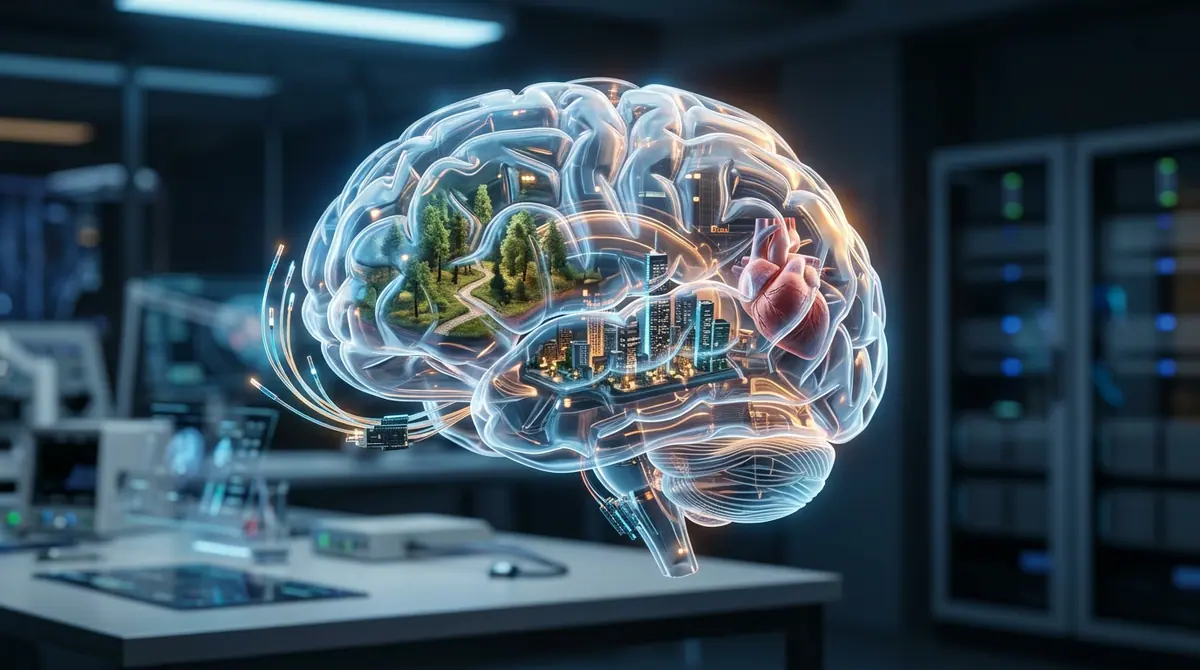
Is AI just a fancy parrot, or is it finally starting to understand the physical world? New research explores the shift from statistical prediction to true 'World Models.'
Key takeaways
- AI is shifting from Large Language Models (LLMs) to World Models that understand physical causality.
- Grounding AI in multimodal data like video, sensors, and touch is the new research frontier.
- Experts like Yann LeCun argue that text-only training cannot lead to human-level intelligence.
- The industry is moving toward 'agentic' systems that can plan and execute complex tasks autonomously.
- Major partnerships, like OpenAI and AdventHealth, are testing these models in high-stakes environments like healthcare.
The Great Understanding Gap
Imagine explaining the concept of gravity to someone who has lived their entire life in a vacuum, never feeling a single ounce of weight. This is the fundamental challenge facing today’s most advanced artificial intelligence. While a model like GPT-4 can write a poem about a falling apple, it does not actually understand that the apple has mass, that it falls at a specific rate, or that it might bruise upon impact. It only knows that the word apple and the word gravity appear together frequently in its training data. According to a series of roundtables hosted by MIT Technology Review AI, the industry is now hitting a wall: to reach the next level of intelligence, AI must move beyond pattern matching and start building robust world models grounded in physical reality.
What Is a World Model?
A world model is essentially a mental map of how the universe works. Humans use these models to predict the future. If you push a glass of water toward the edge of a table, you know it will fall and shatter before it even happens. Current AI, however, is often stuck in a cycle of surface-level correlations. Meta’s chief AI scientist, Yann LeCun, has argued in several public interviews and research talks that language models alone are fundamentally insufficient for human-level intelligence. He suggests that systems need to be trained on richer sensory data, such as video and sensor inputs, to learn causal relationships rather than just predicting the next word in a sentence.
The Importance of Grounding
To bridge this gap, researchers are focusing on something called grounding. This is the process of connecting abstract digital concepts to physical sensations and actions. The MIT course MAS.S60, titled How to AI Almost Anything, highlights this shift by emphasizing the need to ground AI in diverse modalities including vision, audio, medical data, and even smell or taste. By connecting language with multimedia and actual robotic movement, researchers hope to create AI that doesn't just talk about the world but understands how to operate within it.
Context: LLMs vs. World Models
For those new to the field, it is helpful to distinguish between the two. Large Language Models (LLMs) are like master librarians who have read every book ever written but have never stepped outside. World Models are more like toddlers; they might not have the vocabulary yet, but they understand that if they drop a toy, it hits the floor. The goal of modern AI research is to merge the two: giving the librarian the physical intuition of the toddler.
What Changed: The Shift to Multi-Modal Grounding
The biggest delta from previous years is the move away from text-centric training. We are seeing a massive surge in video foundation models and robotics-based AI. These systems use video to learn temporal and physical consistency, essentially watching hours of footage to understand how objects move and interact. This is why tools like Anthropic’s Claude are becoming more than just chat interfaces. In recent product announcements, Anthropic demonstrated how its Claude-based coding tools are moving toward agentic workflows. Instead of just suggesting a line of code, these systems can now interact with repositories, run tests, and debug errors in a way that suggests a deeper understanding of the software's structural reality.
Why It Matters: From Chatbots to Agents
This evolution from prediction to understanding will change how we interact with technology daily. In the creative world, the focus is shifting from simple image generation to scaling creative throughput. According to reports from the MIT Technology Review AI roundtables, AI is moving into the realm of digital mediums like music and art where it doesn't just mimic styles but understands the underlying structure of the medium. In healthcare, the impact is even more profound. OpenAI recently announced a partnership with AdventHealth to advance whole-person care. By using AI to support clinical workflows and patient communication, the goal is to reduce the administrative burden on doctors, allowing them to focus on physical and emotional needs that current AI still struggles to fully grasp.
What to Watch Next
In the coming months, keep an eye on the rise of Agentic IDEs and autonomous robotics. We are moving toward a future where AI does not just answer questions; it observes, plans, and acts. The next big breakthrough will likely come from models that can perform action-conditioned predictions, meaning the AI can simulate the outcome of a specific physical choice before it makes it. Whether we are ready for it or not, software engineering, creative production, and even medical care are being reorganized around these increasingly capable agents.
The Final Word
The debate over whether AI can truly understand the world remains one of the most contentious topics in science. While some argue that understanding is a human-only trait, the practical competence of these new models is undeniable. We are witnessing the birth of machines that no longer just parrot our words but begin to grasp the weight, texture, and consequences of our world.
Sources (4)
Discussion (0)
Commenting as
No comments yet. Be the first to share your thoughts!
The discussion could not be loaded. Please refresh the page.
Mobile ecosystem analyst and smartphone reviewer


