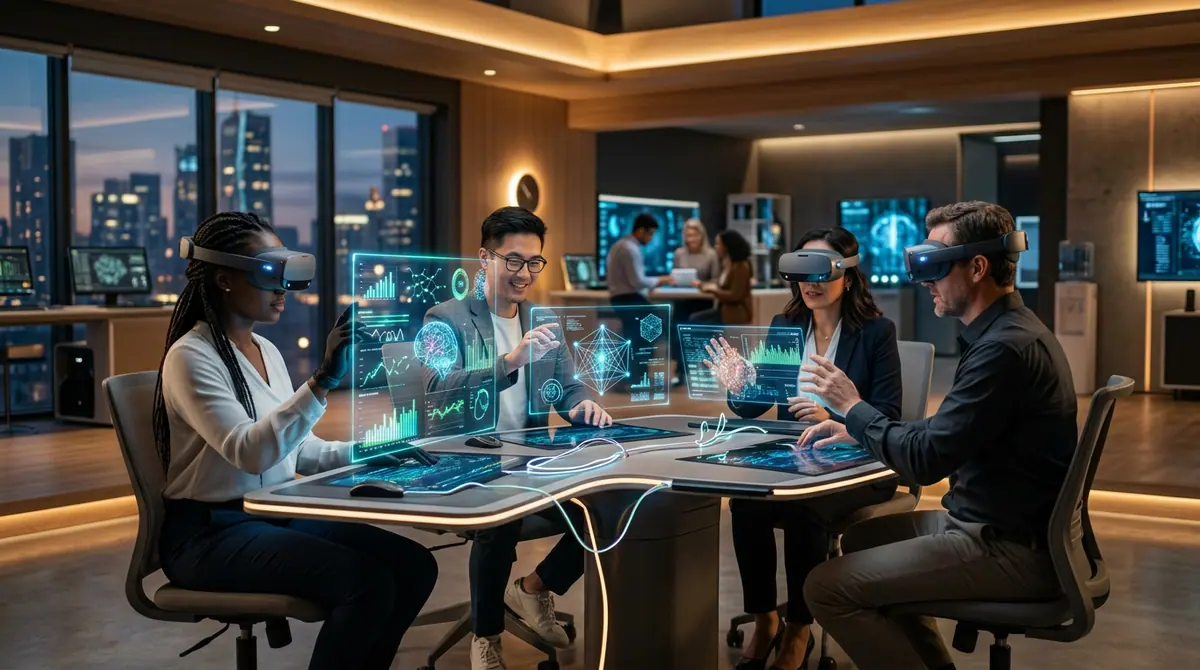
Beyond the Screen: The Invisible AI Revolution Redefining the 2026 Classroom
Discover how AI companions and smart sensors are transforming schools into high-tech hubs where learning is personalized, immersive, and increasingly invisible.

The End of the Traditional Textbook Era
Your child's new favorite teacher might not have a heartbeat, but it knows exactly why they struggled with long division at 8:00 PM last night. This is no longer a futuristic scenario from a sci-fi novel; it is the reality of education in 2026. As we move further into this decade, the technology in our schools is undergoing what experts at CES 2026 call a quiet evolution. We are moving away from clunky software and toward invisible, AI-embedded environments that adapt to students in real time.
The Rise of the Invisible AI Companion
The most significant shift we are seeing this year is the transition from AI as a tool you visit (like a website) to AI as a constant companion. Recent data shows that a staggering 86 percent of students now use AI on a weekly basis. Companies like Google are leading this charge with Gemini-powered features that generate instant lesson summaries and audio modules. Meanwhile, Savvas Learning Company is integrating intelligent companions directly into curricula to provide feedback the moment a student falters.
This is not about replacing teachers with robots. Instead, it is about augmenting the human experience. In Denver Public Schools, administrators are already utilizing grants to fund ethical tools like MagicSchool AI. These platforms assist teachers with the heavy lifting of lesson planning and math instruction pacing, allowing them to focus on the emotional and social needs of their students. The goal is a classroom where the technology is so well integrated that you hardly notice it is there at all.
Physical Play Meets Digital Intelligence
One of the most exciting breakthroughs highlighted at CES 2026 is the return to physical, hands-on learning, but with a high-tech twist. LEGO has advanced the field of STEAM education by introducing interactive building systems equipped with sensors. These sensors provide physical-digital feedback, allowing a student to build a bridge and see a real-time stress analysis on their tablet as they add weight to the physical structure.
This hybrid approach solves the biggest complaint of the early digital era: that children were spending too much time staring at flat screens. By blending cyber-physical environments with AR and VR, schools are creating remote labs where students can conduct 24/7 experiments. Imagine a history student using AR to overlay digital graphics onto their desk, watching a miniature 3D model of a historical figure explain the signing of a treaty as if they were standing right there in the room.
Why Schools Are Getting Pickier
The EdTech market is projected to reach $165 billion by the end of 2026, but this massive growth comes with newfound caution. School districts are facing enrollment declines and tighter budgets, which means the days of buying every shiny new app are over. Today, K-12 leaders are demanding evidence-based outcomes. They are prioritizing tools that demonstrate real learning science and rigorous ethical standards.
This scrutiny is a win for parents and students. It means the tools entering the classroom are safer, more effective, and focused on genuine skill-based hiring needs. As 1EdTech notes, new interoperable standards are making it easier for students to carry digital credentials from one grade to the next, proving they have mastered specific skills rather than just sitting through a lecture.
What This Means for You
For students, the future is incredibly personalized. You will no longer be forced to keep pace with the average of the class; your AI agent will adjust the difficulty of your work as you go. For teachers, the burden of administrative paperwork is finally lifting, replaced by tools that summarize progress and suggest interventions. For parents, the black box of the classroom is opening up, providing clearer data on where your child excels and where they need a little extra help.
The Compelling Path Forward
The classroom of 2026 is a place of flexible layouts, movable walls, and tech-equipped zones for robotics and VR. It is a space designed for wellbeing and sustainability as much as it is for academic rigor. As we look toward events like INTED2026, the message is clear: technology is no longer an add-on to education. It is the very fabric of the learning experience. We are not just teaching children how to use computers; we are teaching them how to thrive in a world where intelligence, both human and artificial, is everywhere.
Discussion (0)
Commenting as
No comments yet. Be the first to share your thoughts!
The discussion could not be loaded. Please refresh the page.
Innovation correspondent with 10 years in Silicon Valley