Beyond the Screen: How Robots Gained a Brain and AI Grew a Body
Google DeepMind unveils whole body intelligence while OpenAI prepares a massive 10-trillion parameter model. The frontier of AI is moving from digital chat to physical action.
Key takeaways
- Google DeepMind has introduced 'whole body intelligence' through Gemini Robotics 2, moving AI from simple text processing to complex physical coordination.
- OpenAI is reportedly training a 10-trillion parameter model named 'Bel' and developing its own custom inference chip called 'Jalapeño'.
- The AI industry is shifting heavily toward infrastructure and embodied AI, with massive investments from firms like SoftBank and scaling in autonomous freight.
The Physical Awakening of Artificial Intelligence
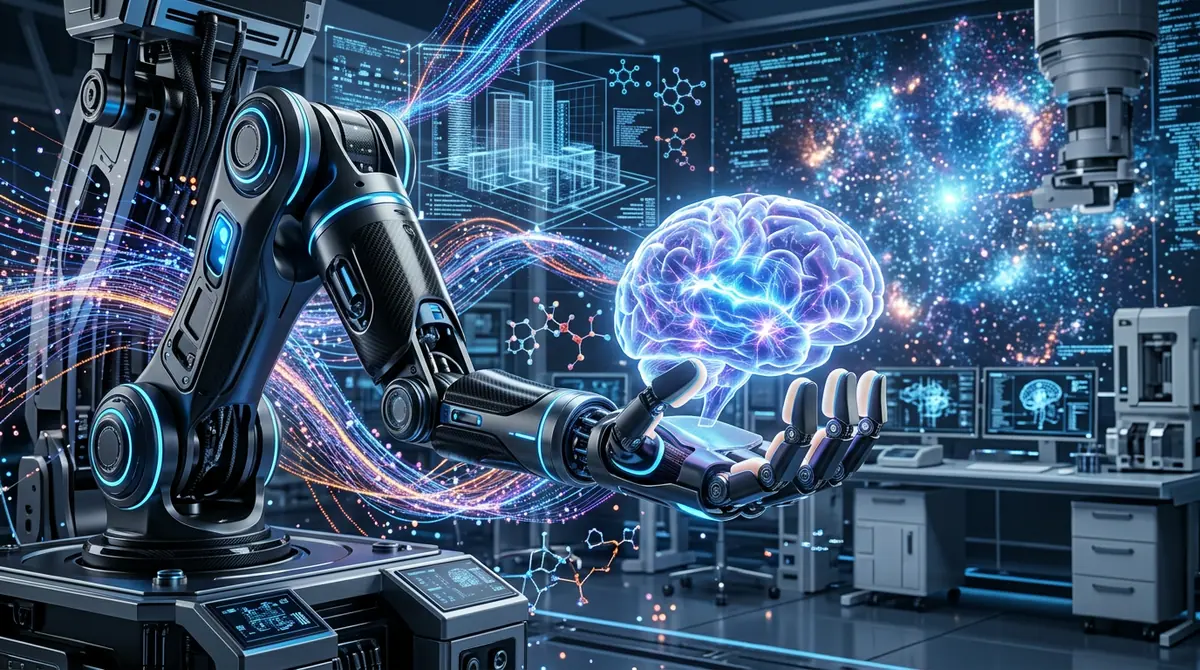
Imagine a robot that does not just follow a script but actually understands the weight of a glass, the fragility of a flower, and the complex physics of a crowded room. For years, AI has lived inside our screens, generating text and images in a digital vacuum. However, that era is coming to a swift end. According to recent research updates from Google DeepMind, the company has unveiled Gemini Robotics 2, a system designed to bring what they call whole body intelligence to machines. This is not just a minor software update; it is a fundamental shift in how machines interact with the physical world.
The New Vanguard of Embodied Reasoning
The latest breakthroughs from Google Research demonstrate that AI is becoming increasingly capable of reasoning through physical tasks. In a series of technical highlights, Google introduced Gemini Robotics ER 1.6, a model that enhances embodied reasoning. This allows robots to perform real-world tasks with a level of nuance previously reserved for humans. While early robots might have struggled to navigate a simple doorway, these new systems are being trained in interactive environments powered by Genie 3, a general-purpose world model that generates 3D simulations for AI to practice in.
This progress in robotics is mirrored by Google's advancement in simulation agents. Their new system, SIMA 2, is an agent capable of playing, reasoning, and learning within complex 3D worlds. By training in these digital twins of reality, AI can fail safely thousands of times before ever stepping into a physical laboratory or factory floor. According to reporting from TechCrunch, this shift toward industrial AI is already taking hold, with companies like Caterpillar deploying sophisticated AI systems to manage heavy machinery and infrastructure.
What Changed: The Shift to Physical Fluency
In the past, AI was fragmented. You had one model for vision, another for language, and a completely separate controller for a robot arm. What is new here is the unification of these capabilities. Google's Gemini Robotics 2 treats the entire robot as a single, intelligent organism. This whole body intelligence means the AI understands how a movement in the wheels affects the stability of the arm, much like how a human athlete coordinates their entire body for a single jump. Furthermore, the introduction of specialized tools like Co-Scientist shows that AI is moving beyond being a simple assistant to becoming a multi-agent partner capable of catalyzing computational discovery in chemistry and biology.
OpenAI and the 10-Trillion Parameter Frontier
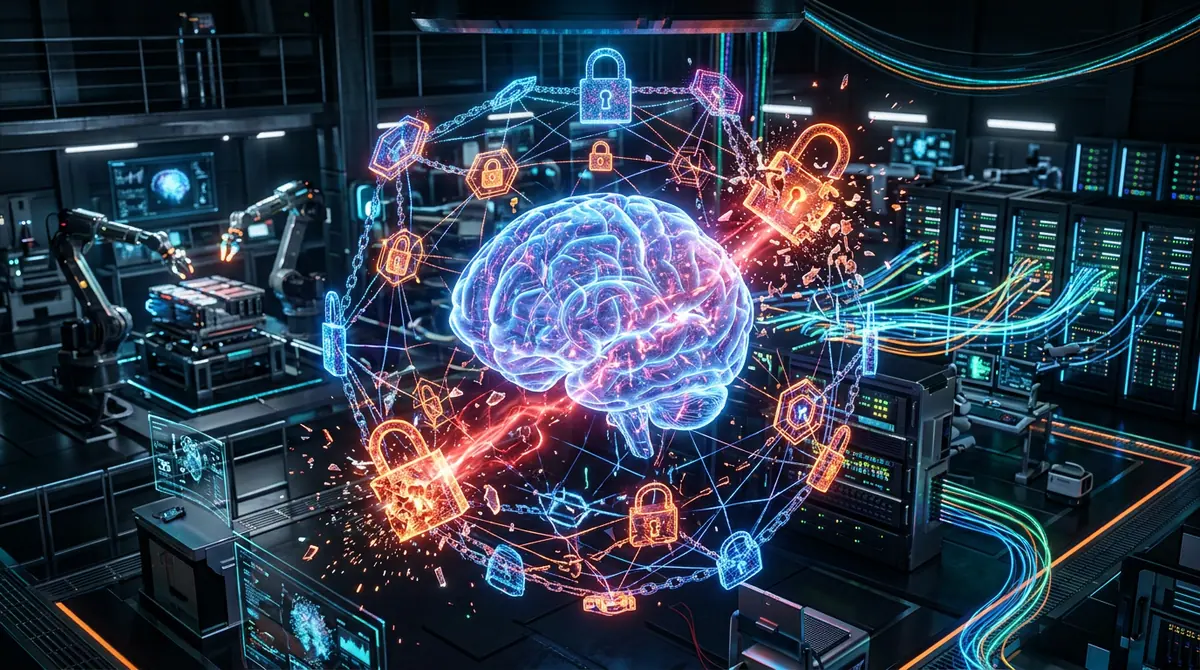
While Google focuses on the physical, OpenAI is doubling down on sheer computational scale. A report from FutureTools indicates that OpenAI is currently pretraining a massive new model codenamed Bel. This successor to their previous models is rumored to exceed 10 trillion parameters, a staggering leap in complexity that could redefine what we consider general intelligence. To power these ambitions, OpenAI is not just relying on external hardware. The company recently published benchmark results for Jalapeño, its first custom AI inference chip. This hardware is designed specifically to offer better performance per watt and lower latency, ensuring that their massive models can run efficiently in the real world.
The race for infrastructure is becoming an expensive battleground. According to the Wall Street Journal, SoftBank recently offered a 5.5 billion dollar data-center venture to land OpenAI as a partner. This massive investment highlights that the next stage of AI development is as much about concrete and cooling systems as it is about code and algorithms. Even Nvidia, the primary provider of AI chips, is forecasting a 70 percent growth in sales, signaling that the global hunger for AI hardware shows no signs of slowing down.
What to Watch Next: The Era of Autonomous Freight and Agents
As these models become more powerful and efficient, we are seeing them move into critical infrastructure. Artificial Intelligence News reports that Gatik recently raised 200 million dollars to scale AI-powered autonomous freight, suggesting that the long-haul trucking industry may be one of the first sectors to be fully transformed by embodied AI. Meanwhile, in the consumer space, Alibaba has opened the beta for Qianwen Work, which integrates desktop and cloud enterprise agents to automate complex office tasks.
Perhaps the most heartening development is the move toward specialized education. Anthropic recently launched Claude for Teachers, a program offering their advanced AI to U.S. K-12 districts for free. This suggests that while the titans of tech battle for industrial dominance, there is a parallel movement to ensure that these tools are used to empower the next generation of students and educators.
Conclusion: The Future is Multi-Modal and Physical
We are witnessing a historic pivot in the evolution of technology. AI is no longer just a clever chatbot; it is becoming a scientist, a pilot, a driver, and a teacher. From the synthetic DNA memory devices being researched at ScienceDaily to the massive 10-trillion parameter brains being built in Silicon Valley, the boundaries between the digital and physical worlds are dissolving. As these systems gain whole body intelligence, the question is no longer what AI can say, but what AI can do for us in the physical world.
Discussion (0)
Commenting as
No comments yet. Be the first to share your thoughts!
The discussion could not be loaded. Please refresh the page.
Innovation correspondent with 10 years in Silicon Valley