
Beyond the Hype: The Stealth Revolution Rebuilding Artificial Intelligence
While chatbots grab the headlines, a deeper transformation is happening in the hidden architecture of AI, from quantum-powered models to memory hacks that make LLMs faster than ever.
Key takeaways
- Google's TurboQuant is solving the memory bottleneck of large models by optimizing KV-cache overhead.
- NVIDIA is bridging the gap between AI and quantum computing with the open-source Ising model family.
- New breakthroughs in biology AI, like CellSAM and MangroveGS, are moving machine learning into high-stakes medical diagnostics.
- The industry is pivoting from massive scale toward extreme efficiency, as seen in neuro-symbolic systems that use 100x less energy.
The Invisible Architect: Why the Next AI Boom Isn't Just About Chatbots
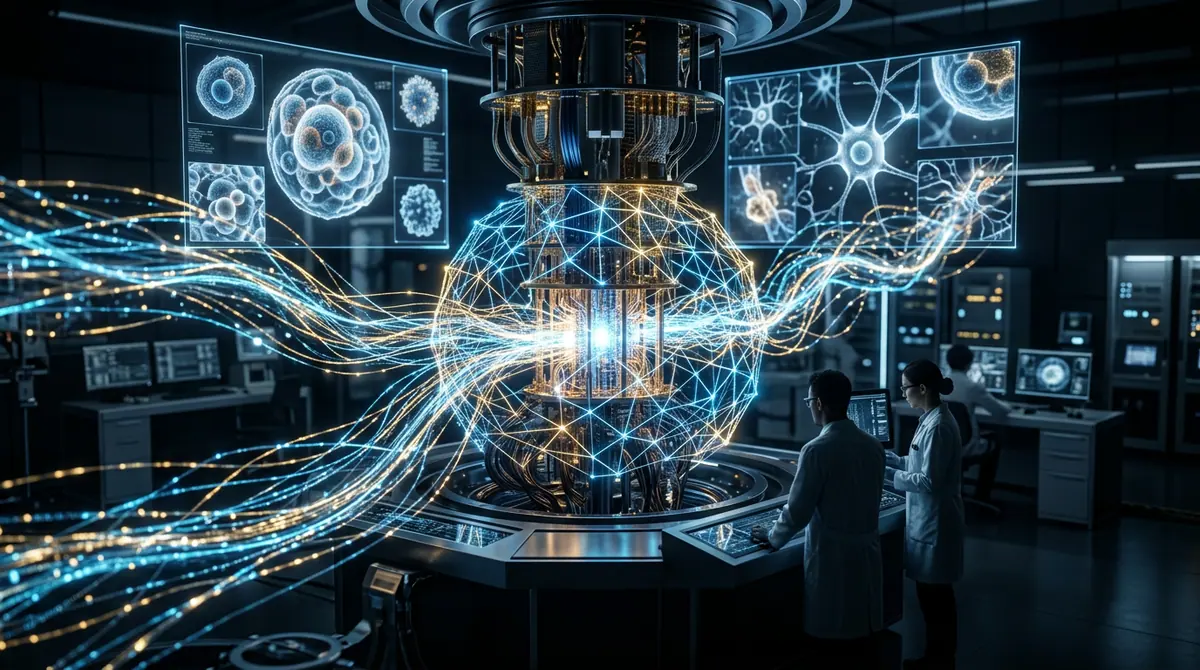
The future of artificial intelligence is no longer just about who has the largest data center; it is about who can do the most with the least. While much of the public's attention remains fixed on the latest chatbot iterations, a silent revolution is rebuilding the foundational architecture of the digital mind. From quantum-ready models to memory hacks that breathe new life into existing hardware, the research community is currently focused on solving the massive bottlenecks that have historically held AI back. According to a report by ScienceDaily, these breakthroughs are moving us toward a world where AI is not just a digital companion but a real-time partner in complex physics and biological research.
Solving the Memory Crisis with TurboQuant
One of the biggest hurdles for large language models is not actually the processing power, but the memory. Specifically, something called the KV-cache memory overhead often acts as a bottleneck during inference, slowing down the model as it tries to recall the context of a conversation. At the ICLR 2026 conference, Google's research team presented a potential solution titled TurboQuant. This technique significantly reduces that memory overhead, allowing models to operate much more efficiently. For users, this means faster response times and the ability to handle much longer documents without the hardware stuttering. By optimizing how the model stores and retrieves data, Google is proving that we do not always need bigger chips; sometimes, we just need better ways to use the ones we have.
Context Box: What is KV-Cache?
For newcomers, the KV-cache (Key-Value cache) is essentially the short-term memory of an AI model. Every time you type a long prompt, the model has to remember the previous words to understand the next one. As the conversation gets longer, this memory takes up massive amounts of space. TurboQuant is like a compression algorithm specifically designed for this short-term memory, ensuring the AI does not get overwhelmed by its own thoughts.
NVIDIA Bridges the Quantum Gap
While Google tackles memory, NVIDIA is looking toward the next frontier of computing. The company recently unveiled Ising, an open-source family of AI models specifically aimed at accelerating quantum computing. According to documentation provided by NVIDIA, these models are designed for quantum error correction and processor calibration. This is a critical development because quantum computers are notoriously sensitive to environmental noise. By using AI to identify and fix errors in quantum calculations, NVIDIA is helping to stabilize a technology that could one day solve problems that would take a traditional supercomputer millions of years to calculate.
AI Enters the Operating Room
The research is also moving out of the server room and into the clinic. At Caltech, researchers have developed CellSAM, a specialized AI that can automatically identify and segment cells across diverse biological images. Published in Nature Methods and made free to researchers, this tool could drastically speed up the pace of biological discovery. Similarly, a report from the University of Geneva highlights a tool called MangroveGS. This AI system can predict whether a cancer will metastasize with roughly 80% accuracy. These are not just incremental updates; they are tools that could change the standard of care for patients worldwide by providing doctors with high-precision insights that were previously impossible to generate manually.
What Changed: The Shift to Efficiency
In the past year, the industry narrative has shifted from pure scale to surgical efficiency. We are seeing a move away from simply adding more parameters to models. Instead, research like the neuro-symbolic AI system from Tufts University is showing that combining neural networks with symbolic reasoning can lead to 100x lower energy use. This shift suggests that the next generation of AI will be characterized by its ability to run on smaller devices, like smartphones or local medical equipment, rather than requiring massive power grids to function.
What to Watch Next
Keep an eye on the development of hybrid light-matter computing. According to research from the University of Pennsylvania, these systems could eventually replace traditional silicon for specific AI tasks, offering even greater speed with a fraction of the electricity. Additionally, TechCrunch reports that companies like OpenAI and Apple are increasingly focusing on safety and specialized agents, such as OpenAI's new Lockdown Mode for data protection and Apple's approval of its first AI agents for business messaging. As these technologies mature, the divide between digital AI and physical world applications will continue to vanish. The real breakthrough isn't that AI can write a poem; it is that AI is finally becoming fast and efficient enough to help us understand the very cells in our bodies and the quantum fabric of the universe.
Sources (6)
Discussion (0)
Commenting as
No comments yet. Be the first to share your thoughts!
The discussion could not be loaded. Please refresh the page.
How-to guide expert and developer advocate


