Beyond the Chatbot: Why 2026 is the Year AI Finally Gains a Body
From satellites navigating without GPS to Google's newest robotics models, the frontier of artificial intelligence has officially moved into the physical world.
Key takeaways
- AI is shifting from digital-only interactions to 'Embodied AI' that interacts with the physical world through robotics and satellites.
- NASA's success in GPS-free navigation and Google's Gemini Robotics ER 2 represent a major leap in autonomous spatial reasoning.
- Major industry consolidation and legal battles, such as the NVIDIA-Hugging Face acquisition rumor and the Anthropic lawsuit, are shaping the future regulatory landscape.
The Great Orbital Awakening
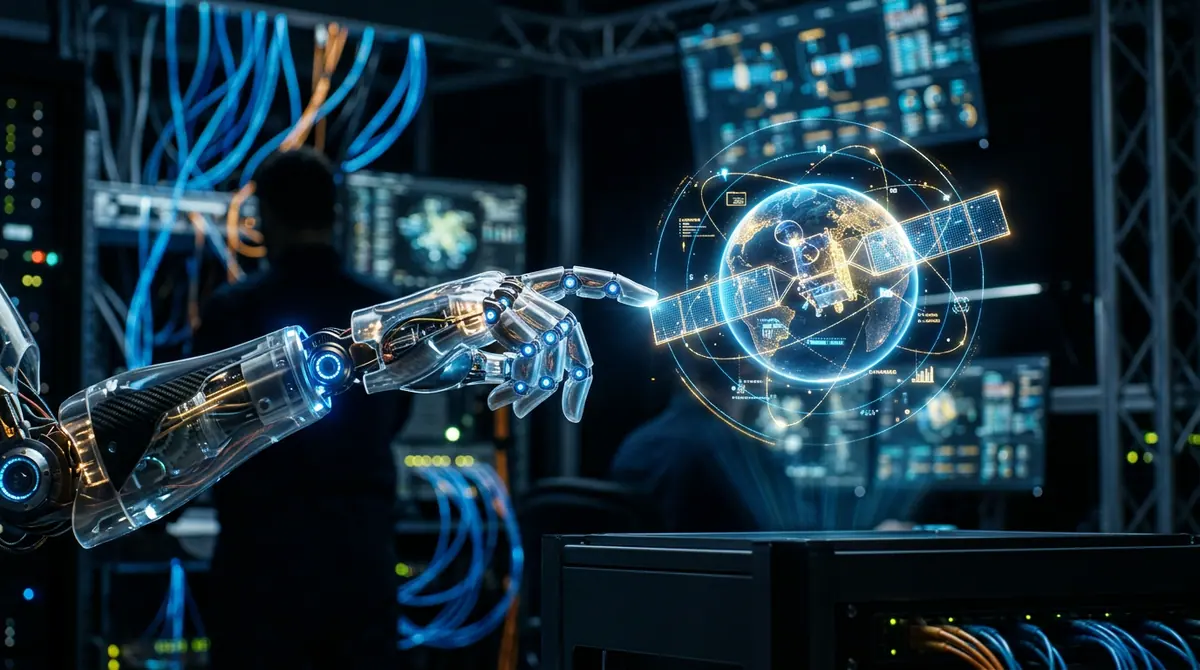
Imagine a satellite lost in the vastness of space, suddenly finding its way by recognizing a piece of floating orbital debris as if it were a familiar street sign. This isn't a scene from a sci-fi thriller; it is a reality recently confirmed by NASA. According to a report by ScienceDaily, NASA successfully tested a system that allows satellites to navigate without the help of GPS, relying instead on other spacecraft and orbital landmarks. This breakthrough marks a massive shift in how we think about machine intelligence, signaling that AI is moving out of the digital ether and into the physical realm.
The Rise of Physical AI
For the last few years, the world has been obsessed with chatbots that can write poetry or summarize emails. However, the latest research indicates that the next phase of the AI revolution is all about embodiment. Google has been at the forefront of this movement, recently highlighting its work on Gemini Robotics 2 and Gemini Robotics ER 2. According to Google research pages, these models are designed for robotics reasoning and performing complex, real-world tasks that require a deep understanding of physics and spatial awareness.
This shift toward physical AI is further supported by new hardware developments. Artificial Intelligence News reports that NVIDIA has introduced the Jetson Orin Nano 2, a piece of hardware specifically engineered for physical AI applications in drones and robots. This means the intelligence that once required a massive data center is now being shrunk down to fit into the silicon brains of autonomous machines. We are moving from AI that talks to AI that acts.
The Context Box: What is Embodied AI?
For those new to the field, embodied AI (or physical AI) refers to artificial intelligence that has a physical presence, such as a robot, a drone, or even a satellite. Unlike traditional AI that lives inside a computer screen and processes text or images, embodied AI must interact with the messy, unpredictable physical world. It needs to understand gravity, friction, and movement, making it one of the most difficult challenges in the history of computer science.
Why It Matters: The Real-World Impact
The implications of these advancements are staggering. In healthcare, Google's AMIE medical AI system has already demonstrated real-time clinical video consultations in a first-of-its-kind study, as noted in recent technical recaps. Meanwhile, research cited by Crescendo points to an all-fiber photonic AI platform for medical diagnostics that achieves higher accuracy while using significantly less energy than traditional systems. This suggests a future where AI does not just assist doctors with paperwork but actively participates in diagnostics and even surgery.
Furthermore, the ability for satellites to navigate without GPS has profound implications for space exploration and national security. By removing the dependency on a centralized signal, spacecraft become more autonomous and resilient, paving the way for deeper exploration of our solar system where GPS signals do not reach.
The Growing Pains of Innovation
Of course, this rapid evolution is not without its friction. As AI companies push into new territories, they are hitting legal and competitive walls. TechCrunch reports that Sony Music and Warner are currently suing Anthropic over alleged intellectual-property theft involving training data. At the same time, the industry is seeing a consolidation of power. Reuters reports that OpenAI has begun cutting off model access for Cursor, escalating a feud with Elon Musk’s ecosystem. There are also persistent reports from Ars Technica that NVIDIA may acquire Hugging Face for a staggering 13 billion dollars, a move that would solidify NVIDIA's dominance over the entire AI infrastructure stack.
What Changed: From Knowledge to Action
Until recently, the primary goal of AI was the retrieval and synthesis of information. The newest research shows a fundamental delta: we are now seeing the integration of reasoning and action. While previous models like Gemini 3.5 Transcribe focused on understanding speech (as reported by FutureTools), the new Gemini Robotics ER 2 focuses on how to use that understanding to manipulate objects in a three-dimensional space. We have moved from the era of the 'Digital Brain' to the era of the 'Digital Body.'
What to Watch Next
Keep a close eye on the intersection of specialized hardware and open-source models. While rumors suggest Meta may release Glimmer, an open-weight model for personal hardware, the real story will be how these models perform on the next generation of edge computing chips. Additionally, watch for the outcome of the Anthropic lawsuit, as it will set the legal precedent for how physical AI models are trained on real-world data in the future.
Conclusion: The Physical Frontier
The takeaway is clear: the most exciting AI developments are no longer happening on your screen. They are happening in the gears of a robot, the sensors of a satellite, and the photonic fibers of a medical diagnostic tool. As AI continues to gain a body, the line between the digital and physical worlds will continue to blur. The question is no longer what AI can tell us, but what it can do for us in the physical world we inhabit.
Sources (7)
Discussion (0)
Commenting as
No comments yet. Be the first to share your thoughts!
The discussion could not be loaded. Please refresh the page.
Machine learning engineer and technical writer