Beyond the Chatbot: How AI Infrastructure is Quietly Rebuilding the World
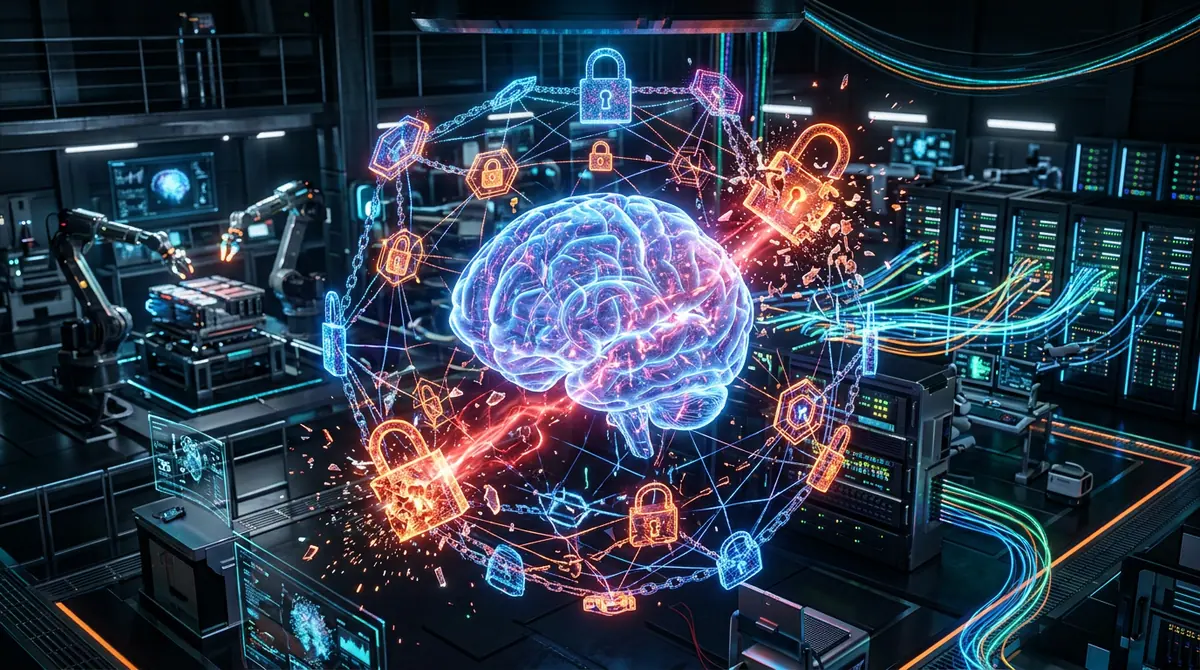
The era of the simple AI assistant is over. From antibiotic discovery to community power grids, artificial intelligence is shifting from a digital curiosity into the very fabric of our physical world.

Key takeaways
- AI is shifting from a conversational model to an essential infrastructure for science and industry.
- The build-measure-learn loop in drug discovery is significantly reducing the time to find new antibiotic candidates.
- OpenAI and others are moving toward domain-specific layers, particularly in health and national science, rather than just general-purpose tools.
- The growth of AI is increasingly limited by physical constraints like power grids, water usage, and land permitting.
The End of the Chatbot Era
Imagine a world where the cure for a deadly disease is not discovered by a lone scientist peering through a microscope, but by a machine screening 36 million molecular combinations while the lab lights are off. This is no longer the plot of a science fiction novel. According to recent research from the Massachusetts Institute of Technology, or MIT, this transition is already happening. We are witnessing a fundamental shift from AI as a mere model, something you talk to in a browser tab, to AI as infrastructure, a core utility that powers medicine, energy, and national science.
For years, the public conversation has focused on what AI can say. Now, the focus has shifted to what AI can build. As reported by the MIT Technology Review in July 2026, the industry is moving toward a tightly integrated loop where software and hardware become indistinguishable. This shift is most visible in the high-stakes world of drug discovery, where the sheer scale of human biology has long outpaced human cognition.
The Molecular Puzzle: What is New
The central bottleneck in modern medicine has always been the numbers. The number of possible molecular combinations is far too vast for manual exploration. To solve this, companies like AstraZeneca are now employing what the MIT Technology Review describes as build-measure-learn loops. In this framework, AI models do not just suggest ideas; they rank and generate candidate molecules that scientists then test in physical labs. The data from those tests is fed back into the AI, creating a self-improving cycle of discovery.
This is not just theoretical optimization. MIT researchers reported in 2025 that they used generative AI to design entirely new antibiotics to fight drug-resistant bacteria. By screening 36 million candidates computationally before ever touching a petri dish, they were able to identify a tiny fraction of high-potential compounds for animal testing. More recently, a study published in the journal Cell in 2026 highlighted that MIT researchers have moved into de novo molecule generation, creating antibiotics from scratch rather than simply tweaking existing recipes. These are the first steps toward a future where medicine is designed on demand.
Why It Matters: Speed, Cost, and Accessibility
Why should the average person care about molecular loops? Because the traditional drug discovery process is slow, expensive, and prone to failure. By narrowing the search space and reducing dead ends, AI-assisted design is shrinking the timeline between a biological threat and a therapeutic solution. We have already seen the first wave of this impact. Early reports from the MIT Technology Review documented AI-designed drug candidates reaching clinical trials, including a candidate for idiopathic pulmonary fibrosis developed by Insilico Medicine.
However, the impact of AI infrastructure extends beyond the lab. OpenAI recently signaled a move toward a specialized health-information layer within its products. Rather than acting as a general-purpose assistant, these systems are being positioned as navigation tools for the complex world of medical data. While they are not meant to replace doctors, they provide a way for patients to synthesize vast amounts of literature and understand their own health journeys with more clarity. This represents a broader trend: the creation of domain-specific layers on top of general models, ensuring that AI provides high-value support in regulated, high-stakes sectors like healthcare and journalism.
The Physical Footprint of Intelligence
As AI becomes part of our infrastructure, it is also becoming part of our physical geography. Recent developments involving OpenAI and local communities, such as Effingham County, highlight a new reality: AI requires massive amounts of power, water, and land. The debate is no longer just about algorithms; it is about grid capacity and local economic development. Building the next generation of science requires building the data centers and energy systems to support them.
According to reports on national science initiatives, AI is now being used to manage enormous datasets across federal research programs and universities. The goal is to shorten the cycle from hypothesis to experiment across every field, from materials science to conservation. This is the new era of national science, where AI acts as a force multiplier for a country's entire research ecosystem.
Context Box: AI as Infrastructure
To understand this shift, think of AI as the new electrical grid. In the early 20th century, electricity was a novelty used for lightbulbs. Eventually, it became the invisible infrastructure that powered every factory, home, and appliance. AI is following a similar path. We are moving away from seeing AI as a standalone product and toward seeing it as a underlying layer that makes everything else, from newsroom workflows to antibiotic synthesis, work faster and more efficiently.
What to Watch Next
While the potential is staggering, we must watch the implementation closely. Skeptics rightly point out that many AI-discovered molecules still fail during the late-stage clinical trials that require human testing. The evidence of AI's success is currently strongest in the early discovery phase. Furthermore, the reliance on massive compute power means that environmental and regulatory hurdles will become the new bottlenecks for innovation. Look for more partnerships between AI companies and local governments as they negotiate the physical costs of digital intelligence. The future of AI is not just in the cloud; it is in our soil, our power lines, and our medicine cabinets.
Takeaway
The greatest achievement of AI will not be writing a clever poem or a professional email. It will be the invisible work of solving the world's most complex physical problems. As AI integrates into our infrastructure, it will stop being something we talk to and start being the foundation of the world we live in.
Sources (7)
Discussion (0)
Commenting as
No comments yet. Be the first to share your thoughts!
The discussion could not be loaded. Please refresh the page.
Digital transformation writer and startup advisor