
Beyond Chatbots: How GPT-5.4 and NVIDIA Rubin are Reshaping Reality
AI has evolved from a novelty into a powerful engine for discovery. From GPT-5.4's reasoning leaps to MIT's drug design, explore how the latest breakthroughs are changing everything.
Key takeaways
- GPT-5.4 has reduced hallucination rates by 45 percent, making it a reliable tool for professional and automated workflows.
- NVIDIA's new Rubin platform offers a 10x reduction in token costs, significantly lowering the barrier to entry for training massive models.
- Generative AI is revolutionizing drug design at MIT, potentially saving billions in the pharmaceutical industry by predicting protein interactions.
- The industry is shifting toward autonomous agentic systems that can self-verify and execute multi-step tasks in tools like Excel and PowerPoint.
The Great Leap Forward: GPT-5.4 and the Rise of the Autonomous Agent
Imagine an assistant that does not just draft your emails but manages your entire supply chain, designs life saving drugs, and operates with nearly zero errors. This is no longer the stuff of science fiction. According to a recent report from InfoWorld, the first half of 2026 has already marked a fundamental shift in how we interact with machines. We have moved past the era of the simple chatbot and entered the age of the autonomous agent, a transition fueled by unprecedented leaps in reasoning and hardware efficiency.
What Changed: From Guessing to Thinking
The most significant catalyst in this transformation is the launch of OpenAI GPT-5.4. Released on March 5, 2026, this model represents the most capable and efficient frontier model ever built for professional work. What makes it different from its predecessors is a 45 percent reduction in hallucination rates when paired with web search. As noted in a blog post by Mean CEO, GPT-5.4 features an extended thinking process that allows it to catch errors before they are presented to the user. In comparisons with previous models, this new architecture produces 80 percent fewer errors during complex reasoning tasks.
While OpenAI pushes the boundaries of reasoning, other players are focusing on sheer scale and efficiency. DeepSeek V4, a massive 1 trillion parameter model released earlier this month, has introduced a MODEL1 architecture that reduces memory requirements by 40 percent. This is achieved through a tiered KV cache system, which allows the model to handle contexts of over one million tokens without the massive computational overhead typically required. This competition between reasoning and efficiency is providing enterprises with a diverse toolkit for every possible use case.
Why It Matters: The Industrialization of Intelligence
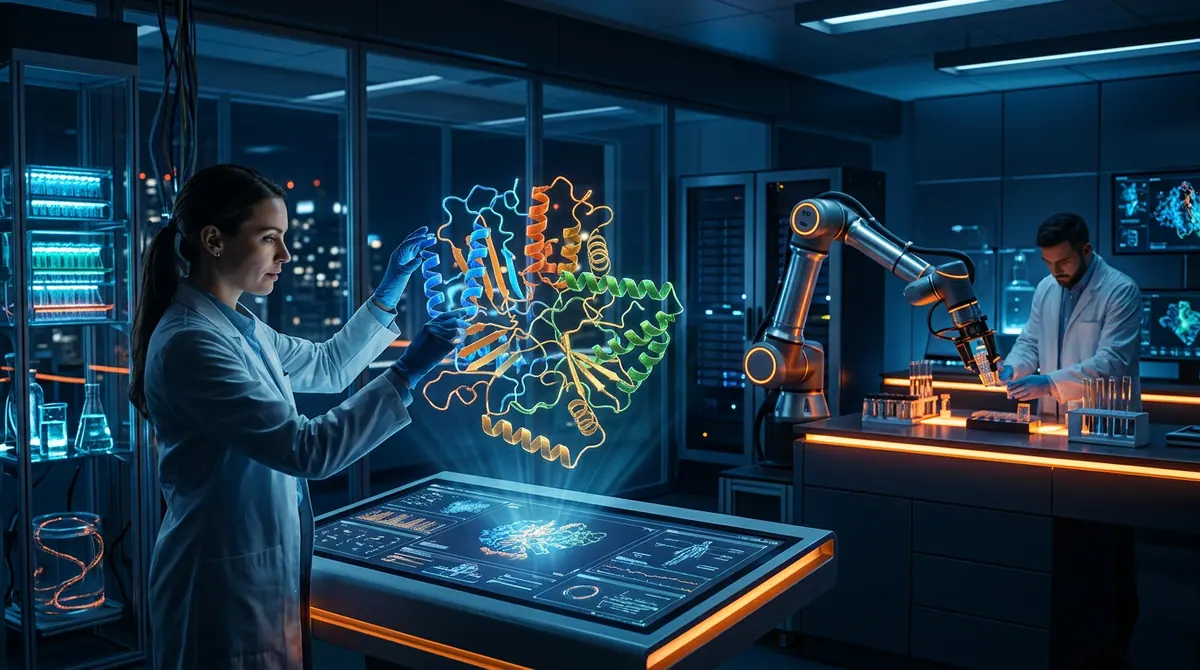
The impact of these models is perhaps most visible in the specialized fields of medicine and engineering. Research breakthroughs at MIT have introduced generative AI specifically designed for protein drug design. This technology can predict synthetic protein folding and target interactions with pinpoint accuracy. According to analysts at Trigyn, this innovation could save the pharmaceutical industry billions of dollars by drastically reducing the number of physical lab trials required for treating cancer, autoimmune diseases, and genetic disorders.
On the professional front, the integration of AI into our daily tools has become seamless. We are seeing ChatGPT for Excel and Claude for PowerPoint becoming standard features, enabling users to automate complex spreadsheet workflows and presentation designs through simple natural language commands. As reported by Julian Goldie, these enterprise tools are moving toward agentic workflows where the AI can self verify its own steps, ensuring that multi step processes are completed without human intervention.
The Silicon Backbone: NVIDIA Rubin
Software cannot evolve without the hardware to support it. NVIDIA has recently unveiled its Rubin platform, a next generation supercomputing architecture that succeeds the Blackwell series. According to details shared by DevFlokers, the Rubin platform features 3rd generation Transformer Engines and NVLink 6, providing a staggering 260 terabytes per second of bandwidth. For developers and companies, the takeaway is clear: the Rubin platform offers a 10 fold reduction in token costs while requiring 4 times fewer GPUs for training compared to previous systems. This hardware leap ensures that the next generation of AI models will be cheaper to run and more accessible to smaller organizations.
What to Watch Next: The Robotic Integration
The next frontier is the physical world. Hyundai, in partnership with Boston Dynamics, has announced a roadmap to integrate these massive language models into modular robots for logistics and personal assistance. These robots will use generative AI for navigation and manual dexterity, moving away from pre programmed movements toward real time adaptive learning. As we move further into 2026, the focus is shifting away from the size of the model toward the reliability and physical integration of intelligence. We are no longer just talking to AI; we are living alongside it.
A Future Built on Reliability
The takeaway for 2026 is that the era of AI experimentation is over, and the era of AI implementation has begun. Whether it is Google Gemini 3.1 Flash Lite providing efficient on device processing for smartphones or the sophisticated agents managing global supply chains, the focus is now on precision and utility. As these systems become more autonomous and less prone to error, the boundary between human intent and digital execution will continue to vanish, promising a future where our most complex problems are solved with the click of a button or a simple spoken command.
Sources (5)
Discussion (0)
Commenting as
No comments yet. Be the first to share your thoughts!
The discussion could not be loaded. Please refresh the page.
Open source advocate and full-stack developer


