
AI Solves Science's Biggest Headaches: From Drug Design to Planetary Cores!
AI is revolutionizing scientific discovery! See how new AI models are accelerating research in drug design, climate modeling, high-pressure chemistry, and beyond. The future of science is here.
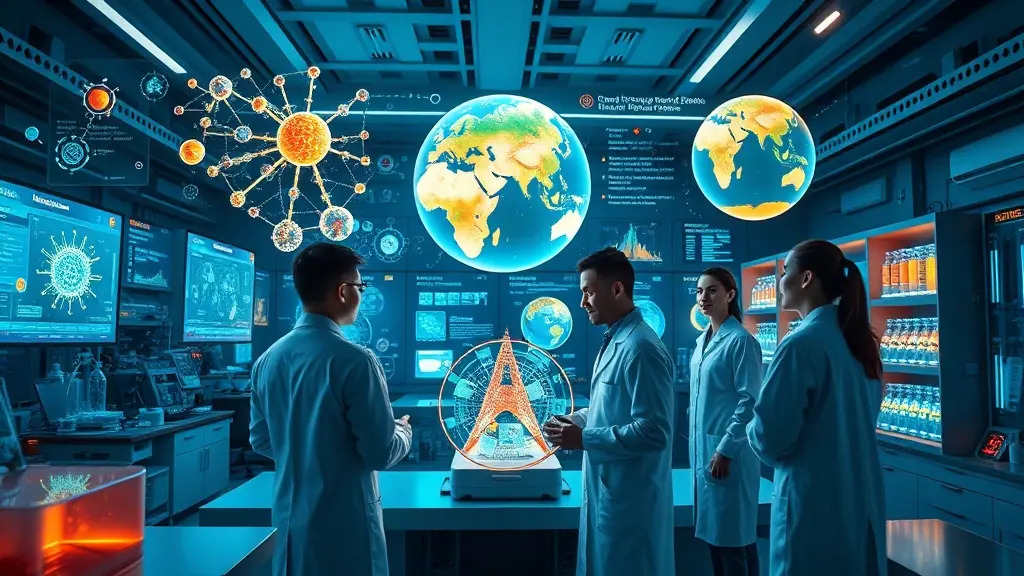
AI's Scientific Revolution: Solving the Unsolvable
Imagine discovering new drugs in months instead of years or predicting the Earth's climate with unprecedented accuracy. What if you could simulate the crushing pressures at the heart of a planet, all on your desktop? This isn't science fiction, it's the reality being forged by the latest breakthroughs in artificial intelligence. And it's happening right now.
While Hollywood portrays AI as robots taking over, the real revolution is far more subtle, yet profoundly impactful: AI is becoming the ultimate scientific assistant, capable of tackling problems previously deemed intractable.
AI's February Breakthroughs: A Glimpse into the Future
February 2026 has been a landmark month for AI in scientific research. Here are just a few of the mind-blowing developments that have emerged:
- Physics-Informed Machine Learning: Researchers at the University of Hawaiʻi have developed an algorithm that ensures AI predictions are physically plausible, even with sparse data. This is a game-changer for fields like fluid dynamics and climate modeling, where data is often limited and the stakes are incredibly high. Imagine more accurate hurricane predictions or designing more efficient aircraft based on real-world physics, not just simulations.
- AI-Powered High-Pressure Chemistry: Simulating the extreme conditions inside planetary cores is notoriously difficult, requiring months of supercomputer time. But now, an AI framework is combining machine learning with quantum calculations to predict atomic bonding under immense pressure, slashing simulation times to mere days. This opens up new avenues for understanding the formation and evolution of planets.
- Generative AI for Protein Drug Design: MIT researchers have unveiled a generative AI model capable of predicting how proteins fold and interact. This has the potential to dramatically accelerate drug discovery, particularly for complex diseases like cancer and genetic disorders, by predicting drug interactions and reducing R&D costs.
New AI Models Emerge
It's not just research, but also new models hitting the scene:
- Theorizer: The Allen Institute for AI (AI2) released Theorizer in early February. This is a new model designed for scientific theory synthesis. Theorizer automates research paper analysis and law extraction, dramatically accelerating the pace of discovery.
- Structured Language Models (SLMs): SLMs emerged, as well, focusing on reliability by minimizing hallucinations, and using predefined reasoning. This makes them ideal for law, finance, and medicine, where accuracy is paramount.
What This Means for You
These breakthroughs may seem abstract, but they have the potential to impact our lives in profound ways. Faster drug discovery could lead to new treatments for previously incurable diseases. More accurate climate models could help us prepare for and mitigate the effects of climate change. And a better understanding of planetary formation could shed light on the origins of life itself.
The Bigger Picture: Specialized AI is the Future
These advancements also highlight a key trend in the AI landscape: the shift towards specialized foundation models. Instead of trying to build one AI to rule them all, researchers are focusing on creating AI models tailored to specific domains, like drug discovery or climate modeling. This allows for greater accuracy, efficiency, and ultimately, more impactful results.
The AI Race is On
The rapid pace of innovation is fueled by intense competition among AI powerhouses like Anthropic, OpenAI, and DeepSeek. These companies are constantly pushing the boundaries of what's possible, with a focus on agentic workflows, context scaling, and reasoning abilities.
Looking Ahead: The Age of AI-Assisted Discovery
We are entering a new era of scientific discovery, one where AI is not just a tool, but a partner. By automating tedious tasks, generating new hypotheses, and analyzing vast amounts of data, AI is empowering scientists to explore the unknown with unprecedented speed and precision. The breakthroughs of February 2026 are just the beginning. The future of science is intelligent, and it's arriving faster than we ever imagined.
Conclusion
AI is no longer just a buzzword; it's a catalyst for groundbreaking discoveries. These developments will accelerate progress across scientific fields and will ultimately improve lives around the world. Stay tuned, the AI revolution in science is just getting started!
Discussion (0)
Commenting as
No comments yet. Be the first to share your thoughts!
The discussion could not be loaded. Please refresh the page.
How-to guide expert and developer advocate


