
AI Revolutionizes Science: AI2's Theorizer & Lab Automation Unleashed!
AI is no longer just analyzing data, it's synthesizing scientific theories and automating lab experiments. Discover the latest breakthroughs transforming research and development!
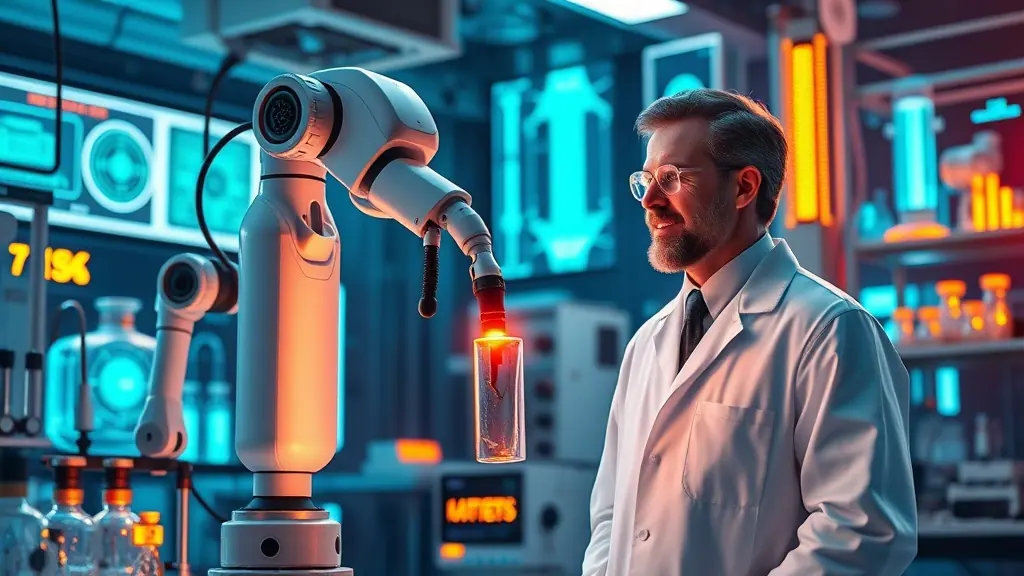
AI is Writing Science Now: Meet Theorizer
Imagine an AI that doesn't just crunch numbers, but actually formulates scientific theories. Sounds like science fiction? Think again. On February 2nd, 2026, the Allen Institute for AI (AI2) unveiled Theorizer, a groundbreaking system capable of automated synthesis of scientific theories directly from research papers. This isn't just a minor upgrade; it's a paradigm shift that addresses critical bottlenecks in experiment automation and data collection, promising to dramatically accelerate the pace of scientific discovery.
What does this mean for you? Imagine a world where researchers can test hypotheses and analyze data faster than ever before, leading to quicker breakthroughs in medicine, materials science, and countless other fields. That future is rapidly becoming a reality.
Agentic AI: From Tools to Autonomous Systems
Beyond Theorizer, the AI landscape is evolving rapidly. 2026 is seeing the rise of Agentic AI, moving beyond isolated tools to integrated, autonomous systems. Key advancements include:
- Post-Training Refinements: Improving AI performance after initial training.
- Open-Source Customization: Allowing researchers and developers to tailor AI models to their specific needs.
- Expanded Context Windows: Enabling AI to consider more information when making decisions.
- Persistent Memory: Giving AI the ability to remember and learn from past experiences.
- Self-Verification: Allowing AI to identify and correct its own errors.
These advancements are crucial for enabling error-free, multi-step workflows and autonomous operations, fundamentally changing how we interact with AI.
Structured Language Models: Reliability in Critical Applications
One of the biggest challenges in AI is ensuring reliability, especially in high-stakes fields like law, finance, and medicine. Structured Language Models (SLMs) are emerging as a solution. These models use predefined reasoning methods for predictions, significantly boosting reliability. SLMs extend hallucination detection beyond single errors, leading to more trustworthy and dependable AI systems.
SYNAPS-I: AI Supercharging Scientific Imaging
Lawrence Berkeley National Laboratory is leading the charge with its SYNAPS-I platform, launched on February 2nd, 2026. This platform integrates AI models across Department of Energy (DOE) facilities, allowing researchers to analyze massive amounts of imaging data from X-ray and neutron sources. SYNAPS-I accelerates discoveries in crucial fields like energy, semiconductors, and medicine through automated image segmentation and particle characterization.
Think about the implications: Faster development of new battery technologies, more efficient solar panels, and more effective cancer treatments. SYNAPS-I is a prime example of how AI is revolutionizing scientific research.
The Rise of Responsible AI
As AI becomes more powerful, it's crucial to address ethical concerns. 2026 is witnessing significant progress in Responsible AI, with improvements in content filtering, bias reduction, and transparent outputs. These advancements are essential for building trust in AI systems and ensuring compliance with regulations. Responsible AI is not just a buzzword; it's a fundamental requirement for the widespread adoption of AI across all sectors.
AI-Driven Decision-Making: Sequencing is Key
How do you best integrate AI into your decision-making processes? Research suggests that the order matters. Sequencing predictive AI (pattern recognition from historical data) before generative AI can lead to sustained innovation. Conversely, using generative AI first can spark novel R&D. The key is understanding the strengths of each type of AI and applying them strategically.
Future Implications
The AI revolution is accelerating, impacting everything from scientific research to everyday decision-making. These advancements promise to transform industries, improve lives, and unlock new possibilities. However, it's also crucial to address the ethical and societal implications of AI, ensuring that these powerful technologies are used responsibly and for the benefit of all.
The breakthroughs of early 2026 are just the beginning. As AI continues to evolve, we can expect even more profound transformations in the years to come. Keep watching this space, the future is being written in AI, one line of code at a time.
Discussion (0)
Commenting as
No comments yet. Be the first to share your thoughts!
The discussion could not be loaded. Please refresh the page.
Innovation correspondent with 10 years in Silicon Valley


