
AI Redefines Reality: Physics-Aware Models & Lightning-Fast Drug Discovery
Groundbreaking AI research is shattering limitations. From predicting extreme chemical reactions to designing life-saving drugs, discover how these advancements are changing science and medicine forever.
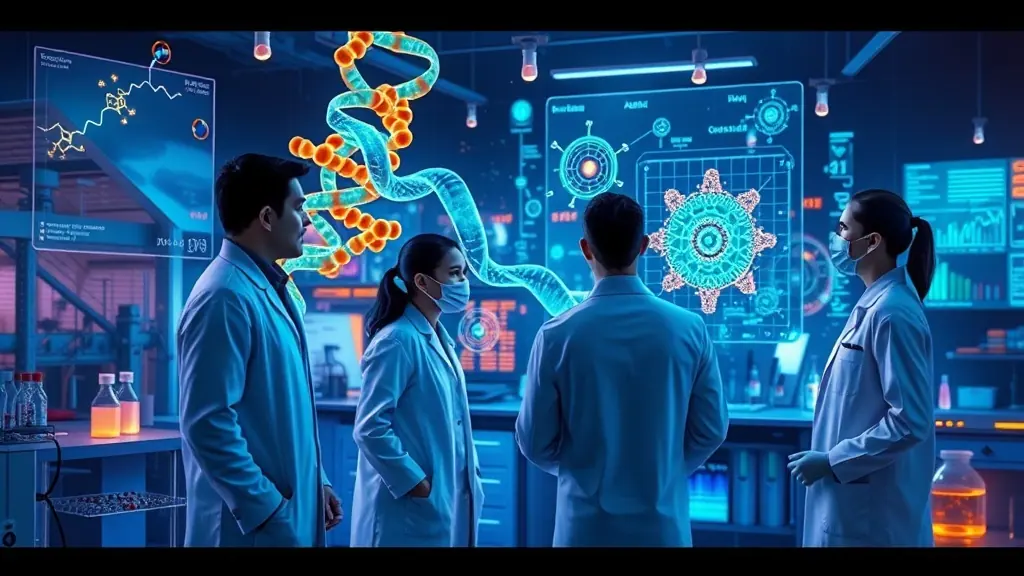
AI's Leap: From Black Boxes to Reality Simulators
Imagine an AI that doesn't just crunch numbers, but understands and respects the fundamental laws of physics. That's precisely what researchers at the University of Hawaiʻi at Mānoa have achieved. They've developed a physics-informed machine learning (ML) algorithm that's making waves in fields ranging from climate modeling to engineering.
Published in *AIP Advances*, this new approach tackles a critical problem with traditional "black box" AI: unreliable predictions. By enforcing physical laws within the AI model itself, the algorithm ensures that its outputs are physically plausible, even when dealing with incomplete or noisy data. Think of it as an AI that's not just smart, but also grounded in reality.
What does this mean for you? Forget AI-generated hallucinations in critical applications. This breakthrough promises more reliable and accurate predictions in areas that directly impact our lives, such as weather forecasting and renewable energy development.
Predicting the Unpredictable: High-Pressure Chemistry with AI
But the innovation doesn't stop there. Scientists are also harnessing AI to simulate chemical reactions under extreme conditions, like those found deep within planetary cores. This new AI system combines machine learning with quantum mechanics, allowing researchers to predict atomic bonding with unprecedented speed and accuracy.
Traditionally, simulating these reactions would take months, if not years. Now, with AI, it can be done in a matter of days. This accelerates the discovery of new materials with unique properties, paving the way for advancements in high-density materials science and our understanding of planetary formation.
AI-Powered Drug Discovery: A Revolution in Healthcare
Perhaps one of the most exciting applications of AI lies in the realm of drug discovery. Researchers at MIT have developed a generative AI model that can predict protein folding and target interactions with remarkable accuracy. This allows for the digital optimization of new drugs, significantly reducing R&D costs and accelerating the development of treatments for diseases like cancer, autoimmune disorders, and genetic conditions.
This is a game-changer for the pharmaceutical industry. By shifting drug discovery to a more programmable paradigm, AI has the potential to revolutionize how we develop and deliver life-saving medications. Imagine a future where personalized medicine is not just a concept, but a reality, thanks to the power of AI.
SYNAPS-I: AI at the Speed of Light (and Neutrons)
The impact of AI is also being felt in large-scale research facilities. The SYNAPS-I AI platform, a multi-lab initiative by the Department of Energy (DOE), is integrating large ML models across seven light and neutron facilities. This allows researchers to analyze petabytes of imaging data in real-time, automating tasks like battery material segmentation and accelerating discoveries in energy, semiconductors, and medicine.
Impulse AI: Democratizing AI for Everyone
Making AI accessible is also becoming a priority. Impulse AI is launching a platform that enables teams to build, deploy, and monitor production-grade AI solutions autonomously. This democratization of AI empowers more organizations to leverage its power, fostering innovation across industries.
The Rise of the AI-Native Workforce
The growing demand for AI expertise is also driving changes in education. The University of North Texas (UNT) recently launched a dedicated AI degree program, signaling a clear alignment between academia and industry needs. This is a crucial step in preparing the next generation of AI professionals.
The Future is Intelligent
- More reliable AI: Physics-informed ML ensures AI predictions are grounded in reality.
- Accelerated discovery: AI is speeding up research in materials science, drug development, and more.
- Democratized access: Platforms like Impulse AI are making AI accessible to a wider range of organizations.
- A skilled workforce: Universities are responding to the growing demand for AI professionals.
The recent breakthroughs in AI are not just incremental improvements; they represent a fundamental shift in how we approach science, medicine, and engineering. As AI becomes more sophisticated and more accessible, we can expect to see even more transformative applications emerge in the years to come. Are you ready for the AI-powered future?
Discussion (0)
Commenting as
No comments yet. Be the first to share your thoughts!
The discussion could not be loaded. Please refresh the page.
Cloud computing specialist and tech trend forecaster


