
AI is Now Designing Medicines We Once Thought Were Impossible to Build
Scientists are moving beyond searching for cures to creating them from scratch. Generative AI is now drafting entirely new antibiotics and proteins to fight once-untreatable diseases.
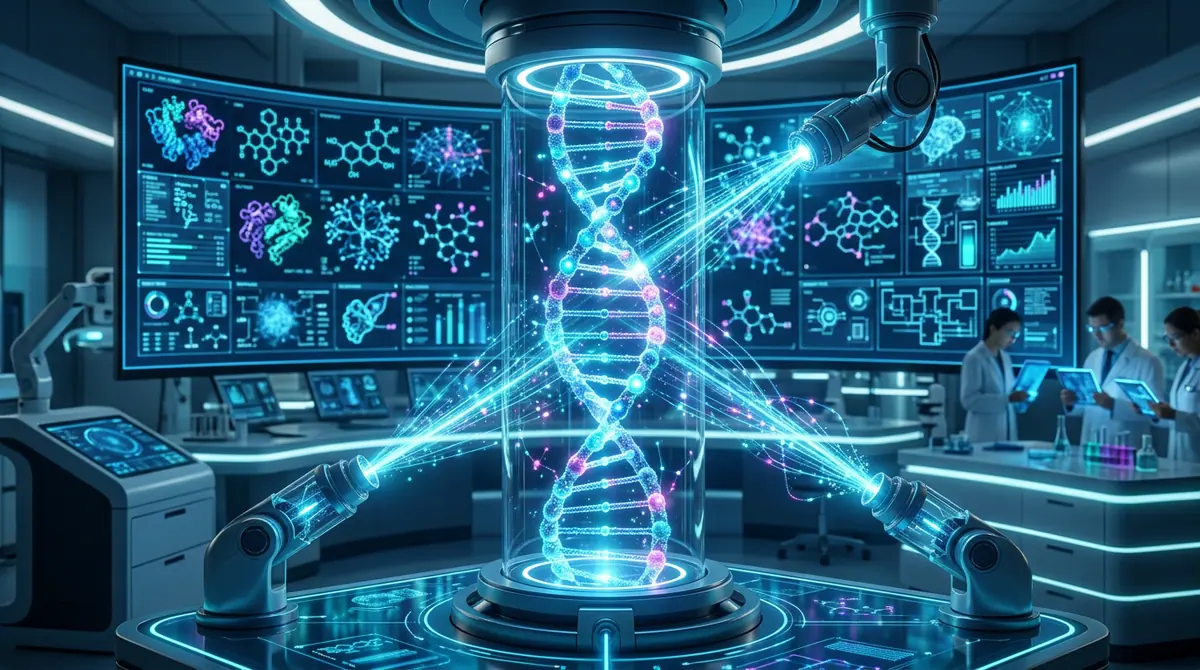
Key takeaways
- AI is transitioning from a passive analysis tool to an active designer of new therapeutic molecules and proteins.
- Generative AI has successfully designed new antibiotics to fight drug-resistant bacteria like MRSA by screening millions of compounds computationally.
- The use of AI is cutting drug development timelines significantly, in some cases moving from concept to animal testing in just 18 months.
- While AI is a powerful accelerator, human validation and rigorous laboratory testing remain essential to ensure safety and efficacy.
The End of the Chemical Needle in the Haystack
For decades, finding a new antibiotic was like looking for a needle in a haystack the size of a galaxy, but AI just turned on a high-powered magnet. We are witnessing a fundamental shift in how human health is protected. According to a report by MIT Technology Review, artificial intelligence is no longer just a tool for analyzing biological data; it has become the primary architect for designing therapeutic molecules from the ground up. This transition marks the end of the brute-force era of drug discovery and the beginning of a generative age where medicines are dreamed up by algorithms before they ever touch a petri dish.
What is New: From Analysis to Design
The traditional pipeline for drug discovery was famously slow, often taking over a decade and billions of dollars to bring a single candidate to market. As MIT researchers explained in a recent series of breakthroughs, the latest generative systems are now capable of proposing and optimizing compounds that humans might never have considered. Instead of screening millions of existing chemicals to see if one happens to work, scientists are using AI to draft the exact molecular blueprints needed to hit a specific disease target. This move toward a tighter build-measure-learn loop means that models rank candidates in seconds, allowing scientists to spend their valuable lab time only on the most promising leads.
The Context Box: What is the Build-Measure-Learn Loop?
In traditional drug R&D, researchers often work in silos: one team finds a target, another synthesizes a chemical, and a third tests it. The build-measure-learn loop, fueled by AI, integrates these steps into a continuous circle. The AI proposes a design (build), the lab tests it (measure), and the data is fed back into the model to improve the next round of designs (learn). This dramatically reduces the time spent on dead ends.
Conquering the Superbugs
One of the most immediate impacts of this technology is in the fight against antibiotic resistance. MIT researchers recently reported using generative AI to design novel antibiotics, including candidates specifically targeting drug-resistant Neisseria gonorrhoeae and MRSA. This was achieved after computationally screening more than 36 million possible compounds, a feat that would be physically impossible for a human team to accomplish in a lifetime. Furthermore, a 2025 study published in the journal Cell demonstrated that generative AI could design completely new antibiotics from scratch, rather than just modifying existing ones. This capability is critical as we face a rising tide of superbugs that have evolved to bypass our current pharmacopeia.
Why it Matters: Reaching the Untreatable
The broader implication of this research is that AI is expanding the boundaries of what is medically possible. MIT Technology Review notes that AI is now helping scientists go after disease targets that were previously considered untreatable. Because the number of possible molecular combinations is so vast, human teams were historically limited to exploring familiar chemical neighborhoods. AI acts as a scout, venturing into the deep unknown of chemical space to find solutions for complex conditions like idiopathic pulmonary fibrosis. In one instance, the company Insilico Medicine used AI to identify both a target and a chemical structure for a candidate that moved from an initial idea to animal testing in just 18 months, an incredible pace by industry standards.
A Reality Check on the AI Hype
Despite these leaps forward, the scientific community remains rightfully cautious. A recent overview in Nature Reviews Drug Discovery characterizes AI as a powerful efficiency enhancer rather than a total replacement for laboratory experiments. While AI can predict how a drug might bind to a protein, the messy reality of human biology often throws curveballs that a computer cannot yet foresee. Additionally, an article in ACS Omega warns that transformative claims require disciplined scientific and ethical controls, noting that the definition of an AI-designed drug is still somewhat fuzzy in the industry. The near-term victory is not fully automated discovery, but rather better prioritization and faster iteration.
What to Watch Next
Keep your eyes on the development of protein-structure prediction models like Boltz-2. According to recent MIT institutional coverage, new versions of these models are adding affinity prediction, which allows scientists to estimate how strongly a drug will stick to its target before they ever build it. As AI continues to integrate with nanoparticle engineering for RNA delivery, we are moving toward a future where we do not just treat symptoms, but engineer precise molecular machines to fix the underlying causes of disease. The era of the digital druggist has officially arrived.
Sources (7)
Discussion (0)
Commenting as
No comments yet. Be the first to share your thoughts!
The discussion could not be loaded. Please refresh the page.
Digital transformation writer and startup advisor